


Performance Indicator 12: Colposcopy rate
Summary colposcopy rate data
Of the participants aged 25–74 who were referred for colposcopy in 2023, 47.0% had a colposcopy within 3 months.
Colposcopy rate
Definition
Percentage of participants aged 25–74 who have a screening or follow-up episode result that places them at higher risk of significant cervical abnormality in a calendar year who attend colposcopy within 3 months.
Rationale
The success of a screening program is reliant on assessment being performed when required. This measures compliance with referral for colposcopy based on a screening episode result or follow-up episode result that places them at higher risk of significant cervical abnormality, and should be calculated for each screening episode result and follow-up episode result.
Data considerations
Colposcopy is the examination of the cervix using a magnifying instrument called a colposcope and is the first step in the assessment stage of the screening pathway.
Prior to 1 February 2021, there were three groups of higher risk participants – two based on primary screening episode results and one based on the follow-up HPV test performed 12 months following an intermediate risk primary screening episode.
Since 1 February 2021, there are four groups of higher risk participants – the same two based on primary screening episode results, one based on the first follow-up screening episode results (including those that would otherwise be intermediate risk but are assigned to higher risk due to being under-screened, Aboriginal and/or Torres Strait Islander, or aged 50 or over), and one based on the second follow-up screening episode.
Time to colposcopy is calculated from the date the test was performed, not the date the participant received a referral to colposcopy. This means the reported colposcopy rate is likely lower than if date of referral to colposcopy was used instead of date of test.
Guide to interpretation
A higher colposcopy rate is better.
This performance indicator is based on primary screening, first follow-up, and second follow-up episodes performed in 2023.
This allows 3 months to 31 March 2024 to know whether a colposcopy occurred, and a further 6 months to 30 September 2024 to ensure that colposcopy and histology data to 31 March 2024 are complete.
Results
Participants whose screening episode, first follow-up episode, or second follow-up episode indicates that they are at higher risk of significant cervical abnormality are referred for colposcopy.
In 2023, there were four groups of participants aged 25–74 who, as a result of their screening episode, first follow-up episode, or second follow-up episode result, were considered higher risk. These were:
- participants whose primary screening HPV test result was oncogenic HPV 16/18
- participants whose primary screening HPV test result was oncogenic HPV (not 16/18) and whose reflex LBC test result was a high-grade squamous abnormality, squamous cell carcinoma, or a glandular abnormality
- participants whose first follow-up HPV test result was oncogenic HPV 16/18 or whose first follow-up HPV test result was oncogenic HPV (not 16/18) and whose reflex LBC test result was a high-grade squamous abnormality, squamous cell carcinoma, or a glandular abnormality (or whose first follow-up HPV test result was oncogenic HPV (not 16/18) and whose reflex LBC test result was negative or a low-grade squamous abnormality and were under-screened, Aboriginal and/or Torres Strait Islander, or aged 50 or over)
- participants whose second follow-up HPV test result was any HPV.
The colposcopy rate of these four groups was calculated as the proportion of participants who had a colposcopy within 3 months (Table 12.1).
Screening or follow-up result | Number of colposcopies | Colposcopy rate (%) |
|---|---|---|
Primary screening test HPV 16/18 + any LBC | 10,045 | 63.2 |
Primary screening test HPV (not 16/18) + high-grade/glandular LBC | 1,765 | 74.8 |
First follow-up test HPV 16/18 + any LBC or HPV (not 16/18) + high-grade/glandular LBC | 2,540 | 23.4 |
Second follow-up test any HPV + any LBC | 4,887 | 41.3 |
Total | 19,237 | 47.0 |
Note: First follow-up test HPV 16/18 + any LBC or HPV (not 16/18) + high-grade/glandular LBC additionally includes first follow-up test HPV (not 16/18) + negative/low-grade LBC in participants who are under-screened, Aboriginal and/or Torres Strait Islander, or aged 50 or over.
Source: AIHW analysis of NCSR data (NCSR RDE 11/07/2025).
Participants whose primary screening HPV test detected oncogenic HPV (not 16/18) and whose reflex LBC test result was a high-grade squamous abnormality, squamous cell carcinoma, or a glandular abnormality had the highest colposcopy rate, with 74.8% of these participants having a colposcopy within 3 months.
The next highest colposcopy rate was for participants whose primary screening HPV test detected oncogenic HPV 16/18, of whom 63.2% had a colposcopy within 3 months.
The colposcopy rate for participants whose second follow-up HPV test detected any oncogenic HPV was lower at 41.3%.
The lowest colposcopy rate was for participants whose first follow-up HPV test detected oncogenic HPV 16/18 or whose first follow-up HPV test detected oncogenic HPV (not 16/18) and whose reflex LBC test result was a high-grade squamous abnormality, squamous cell carcinoma, or a glandular abnormality (or whose first follow-up HPV test result was oncogenic HPV (not 16/18) and whose reflex LBC test result was negative or a low-grade squamous abnormality and who were under-screened, Aboriginal and/or Torres Strait Islander, or aged 50 or over), with 23.4% of these participants having a colposcopy within 3 months.
This is a lower colposcopy rate than has been experienced by this higher risk group in previous reports, and is due to the inclusion of participants whose first follow-up HPV test result was oncogenic HPV (not 16/18) and whose reflex LBC test result was negative or a low-grade squamous abnormality and who were under-screened, Aboriginal and/or Torres Strait Islander, or aged 50 or over, who have a very low colposcopy rate and high enough numbers that the overall colposcopy rate of this higher risk group is lowered.
The total colposcopy rate for all participants referred for colposcopy combined was 47.0%.
Colposcopy rate by age
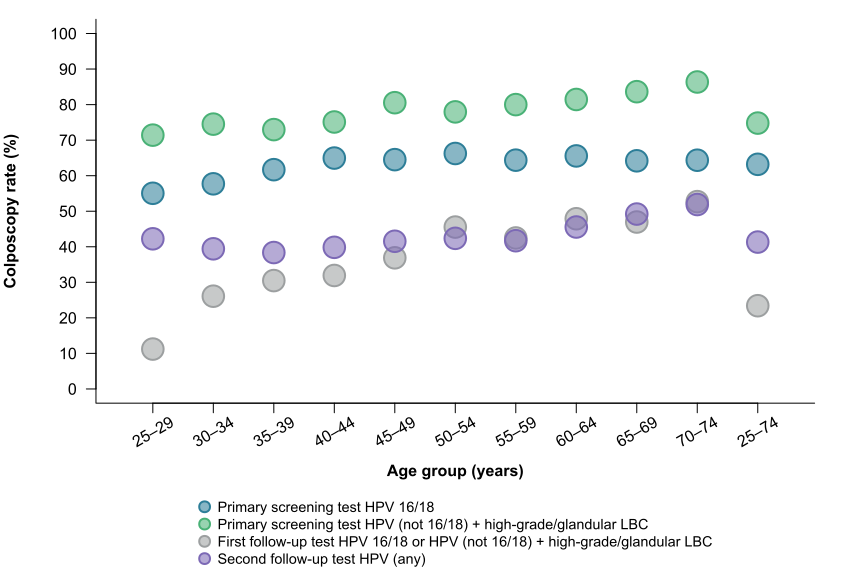
The colposcopy rate is shown by age for each of the four groups of participants referred for colposcopy in Figure 12.1.
Figure 12.1: Colposcopy rate, by screening or follow-up result, by age, 2023
Note: First follow-up test HPV 16/18 + any LBC or HPV (not 16/18) + high-grade/glandular LBC additionally includes first follow-up test HPV (not 16/18) + negative/low-grade LBC in participants who are under-screened, Aboriginal and/or Torres Strait Islander, or aged 50 or over.
Source: AIHW analysis of NCSR data (NCSR RDE 11/07/2025). Data and notes for this figure are available in Table A12.1.
Colposcopy rate trends
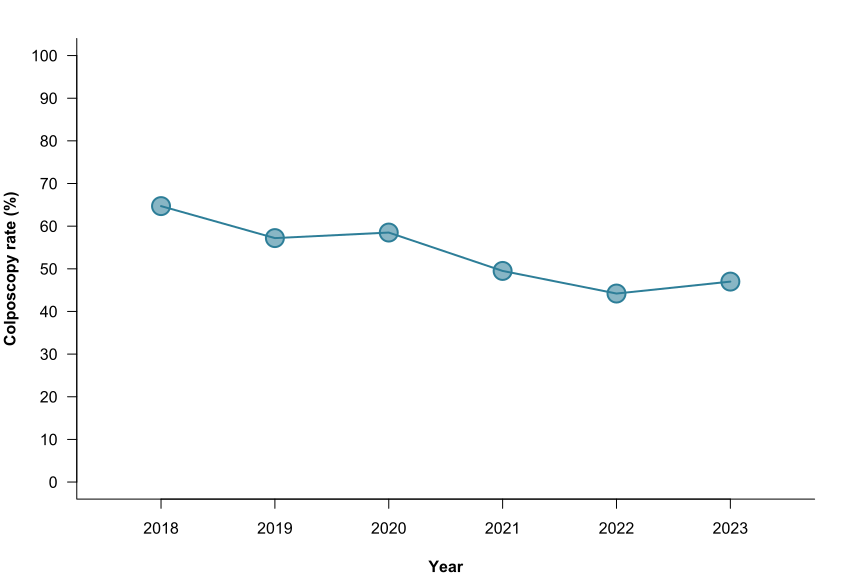
The colposcopy rate for higher risk participants has decreased over time. The colposcopy rate fell from 64.7% in 2018 to 57.2% in 2019 and 58.5% in 2020. Following the introduction of a second follow-up episode and the addition of a new higher risk group, the colposcopy rate decreased to 49.5% in 2021, thereafter decreasing further to 44.2% in 2022 before increasing to 47.0% of participants having a colposcopy within 3 months in 2023 (Figure 12.2).
Between 2018 and 2023:
- the colposcopy rate for participants whose primary screening HPV test result was oncogenic HPV 16/18 increased from 62.9% in 2018 to 64.6% in 2021, before decreasing again to 63.2% in 2023.
- the colposcopy rate for participants whose primary screening HPV test result was oncogenic HPV (not 16/18) and whose reflex LBC test result was a high-grade squamous abnormality, squamous cell carcinoma, or a glandular abnormality increased from 77.0% in 2018 to 78.7% in 2020, before decreasing to 74.8% in 2023.
- the colposcopy rate for participants whose first follow-up HPV test result was oncogenic HPV 16/18 or whose first follow-up HPV test result was oncogenic HPV (not 16/18) and whose reflex LBC test result was a high-grade squamous abnormality, squamous cell carcinoma, or a glandular abnormality (or whose first follow-up HPV test result was oncogenic HPV (not 16/18) and whose reflex LBC test result was negative or a low-grade squamous abnormality and were under-screened, Aboriginal and/or Torres Strait Islander, or aged 50 or over) decreased from 31.4% in 2021 to 23.4% in 2023 (note that trends were recalculated to include participants whose first follow-up HPV test result was oncogenic HPV (not 16/18) and whose reflex LBC test result was negative or a low-grade squamous abnormality and who were under-screened, Aboriginal and/or Torres Strait Islander, or aged 50 or over for all years from 2021 onwards).
- the colposcopy rate for participants whose second follow-up HPV test result was any HPV was 39.8% in 2021, 44.1% in 2022, and 41.3% in 2023.
Figure 12.2: Colposcopy rate, by year, participants aged 25–74, 2018 to 2023
Source: AIHW analysis of NCSR data (NCSR RDE 11/07/2025). Data and notes for this figure are available in Table A12.3.