


Performance Indicator 17a: High-grade cervical abnormality detection rate
Summary high-grade cervical abnormality detection rate data
In 2024, there were 7.2 participants aged 25–74 with a high-grade abnormality detected by histology per 1,000 participants screened.
High-grade cervical abnormality detection rate
Definition
Number of participants aged 25–74 with a high-grade abnormality detected on histology in a calendar year per 1,000 participants screened.
Rationale
The detection of high-grade abnormalities is an indicator of program performance. High-grade abnormalities have a greater probability of progressing to invasive cancer than do low-grade lesions. Detection of high-grade abnormalities provides an opportunity for treatment before cancer can develop, thus the NCSP aims to detect high-grade abnormalities in line with its broader aim to reduce the incidence of cervical cancer.
Data considerations
The participants who have a high-grade abnormality detected on histology (numerator) and the participants who have screened (denominator) are not necessarily the same participants. This may differ from the high-grade abnormality rate calculated by others who may restrict data to screening tests and high-grade histology tests that occur as a result of these screening tests.
This performance indicator is restricted to histology tests notified by pathology laboratories.
This performance indicator is a count of participants, not tests. Where a participant has more than one high-grade abnormality detected, the most serious is counted.
This performance indicator is based on histology performed in 2024.
This allows 6 months to 30 June 2025 to ensure that histology data to 31 December 2024 are complete.
High-grade abnormalities are the result of persistent infection with an oncogenic HPV type. Oncogenic HPV types integrate their DNA into the host genome, which is why these are associated with oncogenic changes to the cells of the cervix (Chhieng & Hui 2011).
As they are potential precursors to cervical cancer, detection of high-grade abnormalities through cervical screening provides an opportunity for treatment before cancer can develop.
Detection of high-grade abnormalities is by histology, which is the primary diagnostic tool of the NCSP. Confirmation of disease is required before treatment is initiated, both to ensure treatment is appropriate and to avoid unnecessary treatment where disease is not present (in Australia it is considered best practice to confirm high-grade disease with histology before treatment (NHMRC 2005)).
The definition of a high-grade cervical abnormality on histology has changed from 2025 onwards. The only recognised high-grade glandular abnormality is adenocarcinoma in situ (AIS); therefore, endocervical dysplasia is no longer included in the definition of a high-grade cervical abnormality on histology.
Results
In 2024, a high-grade cervical abnormality was detected by histology in 12,571 participants aged 25–74, which equates to 7.2 participants with a high-grade cervical abnormality detected per 1,000 participants screened. This means that for every 1,000 participants screened, 7 had a high-grade cervical abnormality detected, providing an opportunity for treatment before possible progression to cervical cancer.
High-grade cervical abnormality detection rate by age
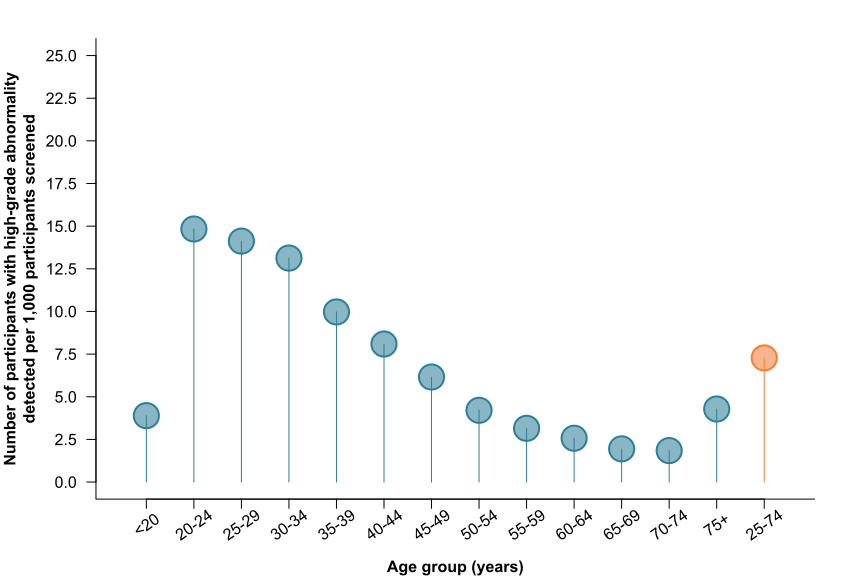
After being low for participants aged under 20 at 3.9 per 1,000 participants screened, the high-grade cervical abnormality detection rate was highest for participants aged 20–24, 25–29, and 30–34 at 14.8, 14.1, and 13.1 per 1,000 participants screened, respectively. Thereafter the high-grade abnormality detection rate decreased with increasing age to reach a low of 1.8 participants with a high-grade cervical abnormality detected per 1,000 participants screened for those aged 70–74 (Figure 17.1).
Figure 17.1: High-grade cervical abnormality detection rate, by age, 2024
Source: AIHW analysis of NCSR data (NCSR RDE 11/07/2025). Data and notes for this figure are available in Table A17.1.
High-grade cervical abnormality detection by histological type
High-grade abnormalities of the cervix include squamous cell abnormalities of moderate grade (CIN 2) and severe grade (CIN 3), as well as cervical intraepithelial neoplasia (CIN) for which the grade has not been specified. High-grade abnormalities of the cervix also include the endocervical high-grade abnormality adenocarcinoma in situ (AIS).
The histological types of high-grade abnormalities included in the high-grade cervical abnormality detection rate were examined (noting that if a participant had more than one high-grade cervical abnormality detected, the most serious abnormality was included).
Data for the target age group 25–74 are summarised in Table 17.1.
CIN 3 was present in more than half (59.6%) of the participants in whom a high-grade cervical abnormality was detected, with CIN 2 the next most common abnormality, present in 32.3% of the participants in whom a high-grade cervical abnormality was detected.
As expected, endocervical abnormalities were rarer. Adenocarcinoma in situ, was found in 2.9% of the participants in whom a high-grade cervical abnormality was detected.
High-grade abnormality | CIN NOS | CIN2 | CIN3 | AIS |
|---|---|---|---|---|
Number | 653 | 4,061 | 7,495 | 362 |
Per cent | 5.2 | 32.3 | 59.6 | 2.9 |
Note: CIN = cervical intraepithelial neoplasia; AIS = adenocarcinoma in situ; NOS = not otherwise specified; AIS includes AIS and mixed CIN3/AIS.
Source: AIHW analysis of NCSR data (NCSR RDE 11/07/2025). Data by 5-year age groups are available in Table A17.2.
High-grade cervical abnormality detection by screening history
To understand the impact of screening history, high-grade cervical abnormality detection is reported for participants who are recently-screened, under-screened, and never-screened.
The usual methodology for calculating high-grade cervical abnormality detection cannot be used to look at screening history, because participants with a high-grade histology detected are not a subset of participants screened, and screening history is based on the date of screen. Therefore a cohort approach to calculate high-grade cervical abnormality detection is instead used so that the oncogenic HPV test that preceded the high-grade histology can be used to assign participants as recently-screened (previous screen was in the last 6 years), under-screened (previous screen was more than 6 years ago), or never-screened (no previous screen), at the time of the oncogenic HPV test.
When this cohort approach is used, the high-grade abnormality rate in 2024 for participants aged 25–74 was 5.4 participants with a high-grade cervical abnormality detected per 1,000 participants screened where the high-grade histology occurs within 6 months of the screen (note that it is expected that the cohort methodology would result in a different high-grade abnormality detection rate to the rate produced by the usual methodology).
High-grade cervical abnormality detection by screening history using this cohort approach is shown in Figure 17.2 for participants aged 25–74.
High-grade cervical abnormality detection using the cohort approach was lowest for recently-screened and under-screened participants at 5.2 and 5.0 participants with a high-grade cervical abnormality detected per 1,000 participants screened, respectively. High-grade cervical abnormality detection was higher for never-screened participants at 6.7 participants with a high-grade cervical abnormality detected per 1,000 participants screened.
Figure 17.2: High-grade cervical abnormality detection rate, by screening history, participants aged 25–74, 2024
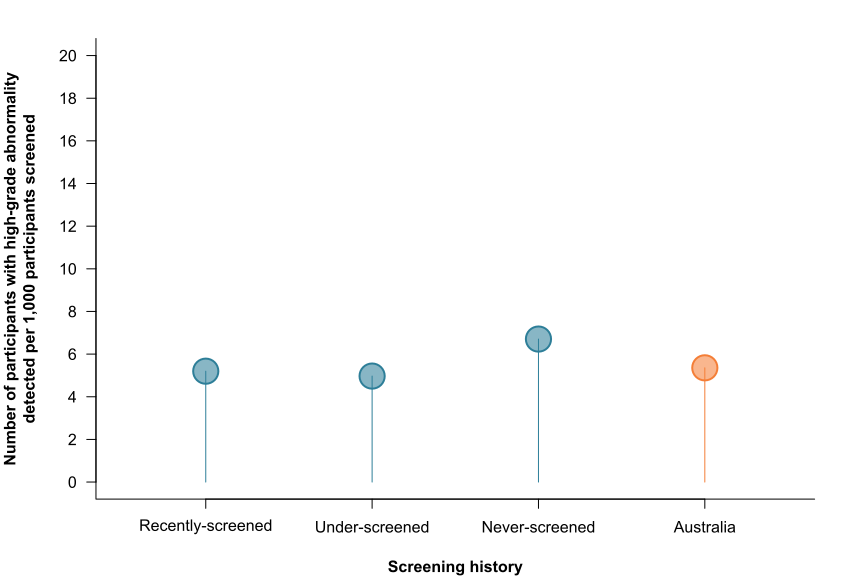
Note: The usual methodology for calculating high-grade cervical abnormality detection cannot be used to look at screening history, therefore a cohort approach to calculate high-grade cervical abnormality detection is instead used so that the oncogenic HPV test that preceded the high-grade histology can be used to assign participants as recently-screened, under-screened, or never-screened at the time of the oncogenic HPV test. Recently-screened is defined as participants whose previous HPV, LBC, or Pap test was in the 6 years prior to their oncogenic HPV test; Under-screened is defined as participants whose previous HPV, LBC, or Pap test was more than 6 years prior to their oncogenic HPV test; Never-screened is defined as participants who had no previous HPV, LBC, or Pap test prior to their oncogenic HPV test.
Source: AIHW analysis of NCSR data (NCSR RDE 11/07/2025). Data and notes for this figure are available in Table A17.4.
High-grade cervical abnormality detection rate trends
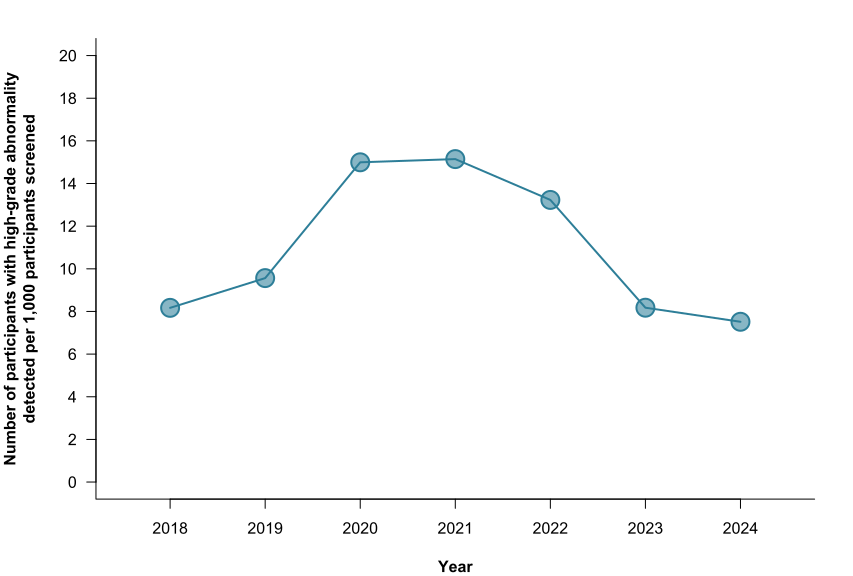
After adjusting for age, the high-grade abnormality rate increased from 8.2 participants with a high-grade cervical abnormality detected by histology per 1,000 participants screened in 2018, to 9.6 in 2019, to 15.0 in 2020, and to 15.1 in 2021. The high-grade cervical abnormality rate then decreased slightly to 13.2 in 2022, before decreasing further to 8.2 participants with a high-grade cervical abnormality detected by histology per 1,000 participants screened in 2023, similar to the high-grade abnormality rate in 2018. The high-grade abnormality detection rate decreased further to 7.5 participants with a high-grade cervical abnormality detected by histology per 1,000 participants screened in 2024 (Figure 17.3).
Figure 17.3: High-grade cervical abnormality detection rate, by year, 2018 to 2024
Source: AIHW analysis of NCSR data (NCSR RDE 11/07/2025). Data and notes for this figure are available in Table A17.5.