


Performance Indicator 14: Biopsy rate
Summary biopsy rate data
A biopsy was reported to have been performed in 38.7% of reported colposcopies for participants aged 25–74 in 2024.
Biopsy rate
Definition
Percentage of colposcopies in participants aged 25–74 in which a biopsy was performed in a calendar year.
Rationale
Although there are reasons why a biopsy would not be performed at colposcopy, a lower than expected biopsy rate would require further investigation.
Data considerations
Colposcopy data in the NCSR come from several sources. One source is the colposcopy form, which includes information on the colposcopy itself including whether a biopsy was performed, as well as treatment details. While colposcopy data are also sourced from MBS, this level of information is not available for colposcopies for which MBS is the only data source. Therefore, biopsy rate is calculated using only colposcopies for which the source of data is a colposcopy form. Consequently, the biopsy rate may not be an accurate reflection of the true biopsy rate for the NCSP.
Results
In 2024, there were 89,621 colposcopies performed for participants aged 25–74 as indicated by a completed colposcopy form. A biopsy was reported to have been performed at 34,669 (38.7%) of these colposcopies.
To better understand why a biopsy may or may not be performed, the biopsy rate is shown according to indication for colposcopy (reason why colposcopy was performed) (Table 14.1) and colposcopy impression (impression of colposcopist at time of colposcopy) (Table 14.2).
From these tables it can be seen that the reason why a participant was referred to colposcopy had an influence on whether a biopsy was performed, with an indication for colposcopy of 'New patient with abnormal cervical screening result' having the highest biopsy rate of 45.3%, followed by an indication for colposcopy of 'Abnormal appearance of cervix' at 44.5% (Table 14.1).
The colposcopy impression also had a major influence, with a biopsy much more likely to be performed where the colposcopist identified an abnormality. The biopsy rate was 84.7% for LSIL (squamous low-grade abnormality), 73.9% for HSIL (squamous high-grade abnormality), 70.7% for a glandular abnormality, and 84.6% for cancer (Table 14.2).
Indication for colposcopy | Number | Biopsy rate (%) |
|---|---|---|
Not performed | 0 | 0.0 |
New patient with abnormal cervical screening result | 20,783 | 45.3 |
Follow-up of patient with previous abnormal cervical screening result | 8,082 | 31.8 |
Symptomatic | 2,834 | 35.1 |
Abnormal appearance of cervix | 938 | 44.5 |
At time of treatment | 699 | 21.7 |
Other | 657 | 21.8 |
Missing | 676 | 35.5 |
Total | 34,669 | 38.7 |
Note: There are a small number of colposcopies for which the Indication for colposcopy was incorrectly assigned to 'Not performed'.
Source: AIHW analysis of NCSR data (NCSR RDE 11/07/2025).
Colposcopy impression | Number | Biopsy rate (%) |
|---|---|---|
Normal | 2,713 | 8.9 |
No Visible Lesion | 2,003 | 10.5 |
LSIL | 19,304 | 84.7 |
HSIL | 6,730 | 73.9 |
Glandular Abnormality (adenocarcinoma in situ) | 118 | 70.7 |
Cancer | 148 | 84.6 |
Other | 2,694 | 50.0 |
Missing | 959 | 39.7 |
Total | 34,669 | 38.7 |
Note: LSIL = low-grade squamous intraepithelial lesion (low-grade abnormality); HSIL = high-grade squamous intraepithelial lesion (high-grade abnormality)
Source: AIHW analysis of NCSR data (NCSR RDE 11/07/2025).
Biopsy rate by age
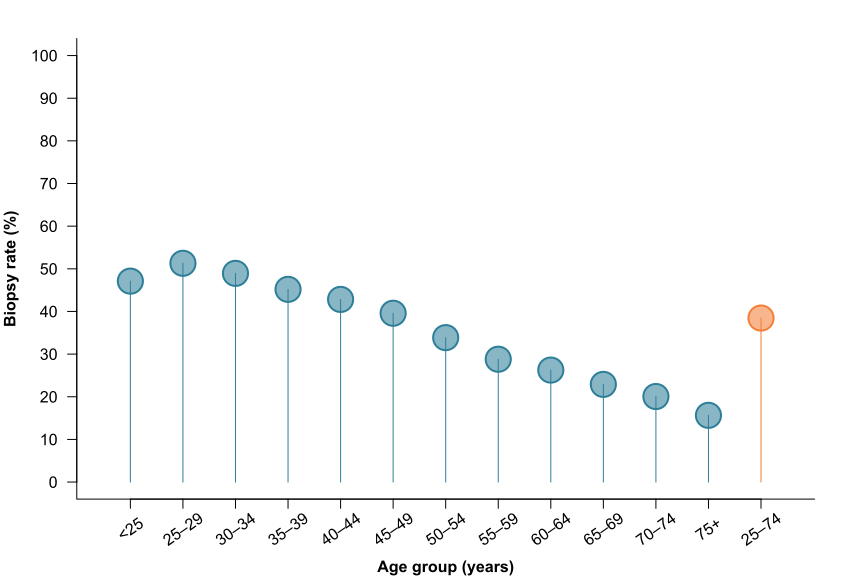
Age also affected whether a biopsy was performed at colposcopy, with a biopsy more likely at colposcopies performed for younger participants (highest at 51.3% for participants aged 25–29), thereafter decreasing with increasing age (Figure 14.1).
Figure 14.1: Biopsy rate, by age, 2024
Source: AIHW analysis of NCSR data (NCSR RDE 11/07/2025). Data and notes for this figure are available in Table A14.1.
Biopsy rate trends
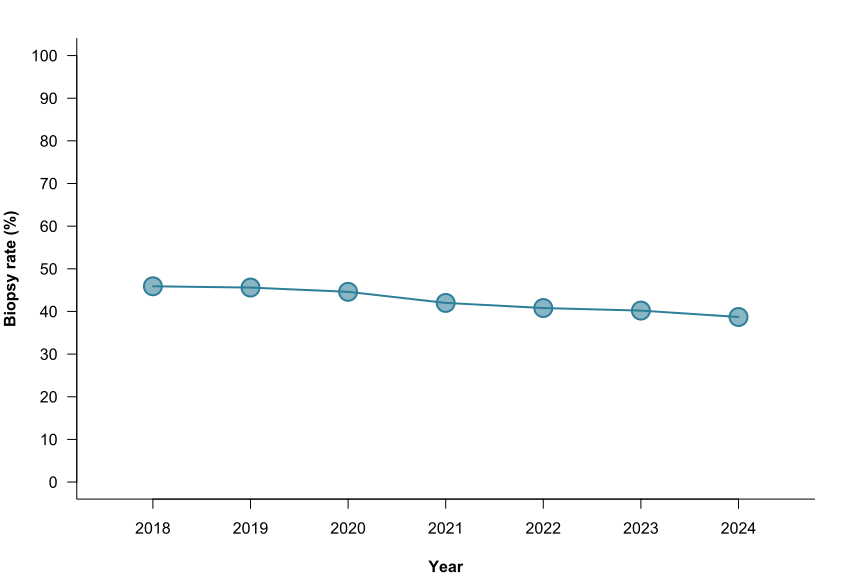
The proportion of colposcopies at which a biopsy was performed has decreased over time, from 45.9% in 2018 to 38.7% in 2024 (Figure 14.2).
Figure 14.2: Biopsy rate, by year, participants aged 25–74, 2018 to 2024
Source: AIHW analysis of NCSR data (NCSR RDE 11/07/2025). Data and notes for this figure are available in Table A14.3.