


Performance Indicator 4: Screening results
Summary of screening results data
Of the 1,350,908 primary screening episodes in 2024 in participants aged 25–74:
- 92.1% were low risk
- 5.0% were intermediate risk
- 1.6% were higher risk
- 1.3% could not be assigned a risk
Screening results
Definition
Percentage of screening episodes in participants aged 25–74 in each risk category in a calendar year.
Rationale
Distribution of screening episode results is a key measure for the screening program and any changes in these distributions over time will require investigation within the broader context of the screening program.
Guide to interpretation
There are three risk categories (low, intermediate, and higher) for a primary screening episode that are determined by a combination of the primary screening HPV test result and, where indicated, the LBC test result. Risk is defined as the risk of a significant cervical abnormality. Determination of risk is illustrated in the screening pathway and described below.
A primary screening HPV test that does not detect oncogenic HPV indicates low risk, and no reflex LBC is performed.
A primary screening HPV test that detects oncogenic HPV 16/18 indicates higher risk, and while reflex LBC is performed, the outcome of this test does not affect the risk.
A primary screening HPV test that detects oncogenic HPV (not 16/18) does not indicate a risk on its own, but requires reflex LBC to be performed to determine whether the risk is intermediate or higher:
- a reflex LBC test result of negative or low-grade abnormality indicates intermediate risk
- a reflex LBC test result of high-grade abnormality or glandular abnormality indicates higher risk.
Considerations
The reflex LBC can occur on a later date than the primary screening HPV test if the HPV test is self-collected and oncogenic HPV is detected, or if the reflex LBC test is unsatisfactory and needs to be repeated. In the case that an unsatisfactory LBC test is repeated, the repeat LBC test result is reported in place of the initial unsatisfactory LBC test result. In both cases, a reflex LBC occurring on a later date is only included in the risk assessment if it occurs within 6 months of the primary screening HPV test.
In some cases, a primary screening HPV test that does not detect oncogenic HPV is followed by an LBC, despite this not being indicated. These episodes have been allocated a risk according to their LBC test result, which is intermediate or higher if the LBC is not negative.
There are also some primary screening episodes for which a risk cannot be allocated, usually due to unsatisfactory tests. Note that if a primary screening test is repeated due to an unsatisfactory test, the repeat test will also have a 'reason for HPV test' of primary screening HPV test. Unsatisfactory HPV tests that are followed by an LBC are only allocated a risk if the LBC indicates a high-grade abnormality, glandular abnormality, or cancer (higher risk).
Results
In 2024, there were 1,350,908 primary screening episodes in participants aged 25–74. These primary screening episodes were assigned to one of the three risk categories of low, intermediate, or higher (or were unable to be assigned) based on the combination of the HPV test result and, where indicated, the LBC test result. This is explained in the 'Guide to interpretation' for this performance indicator.
Overall, of the primary screening episodes in 2024 in participants aged 25–74:
- 92.1% were low risk
- 5.0% were intermediate risk
- 1.6% were higher risk
- 1.3% could not be assigned a risk because either they were unsatisfactory for evaluation, or there was no LBC test performed after an HPV test detected oncogenic HPV, likely because either a participant did not return for a subsequent LBC test, or an LBC test was not performed at colposcopy within 6 months of a self-collected sample.
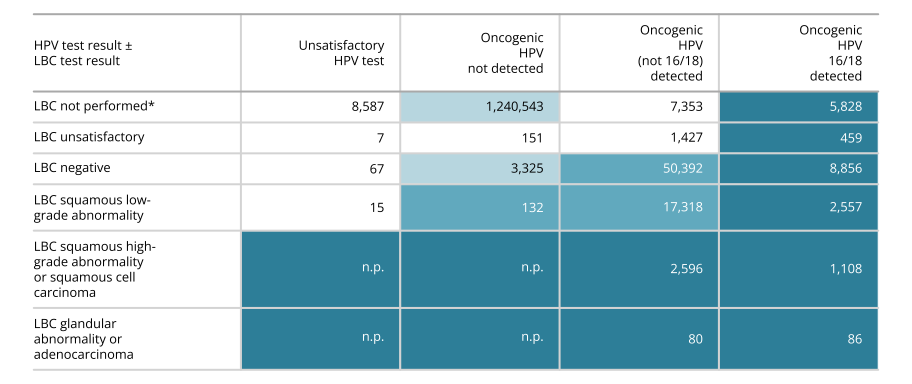
In Table 4.1, the combination of primary screening HPV test result and LBC test result is shown for each primary screening episode.
Each combination has been colour-coded in this table according to risk of significant cervical abnormality. Low risk is indicated by light shading, intermediate risk is indicated by medium shading, and higher risk by darker shading. Primary screening episodes for which a risk could not be assigned have no shading.
Figure Table 4.1: Primary screening HPV ± LBC test results, participants aged 25–74, 2024
Low risk
All low risk screening results were in participants who had a primary screening HPV test that did not detect oncogenic HPV. Of the 1,244,166 of this type, 1,240,543 did not have a reflex LBC, and among the 3,623 that did have a reflex LBC, 3,325 had a negative LBC.
Intermediate risk
The majority of intermediate risk screening results were in participants who had a primary screening HPV test that detected oncogenic HPV (not 16/18) and had a reflex LBC that was negative or indicated a low-grade squamous abnormality (67,710 of the 67,842 intermediate risk screening results). There were also 132 screening episodes in which the primary screening HPV test did not detect oncogenic HPV but had a reflex LBC that indicated a low-grade squamous abnormality that were deemed intermediate risk.
Higher risk
Higher risk screening results were in participants who had a primary screening HPV test that detected oncogenic HPV 16/18 and/or who had a reflex LBC that indicated a high-grade squamous abnormality, squamous cell carcinoma, or any glandular abnormality. There were 18,894 screening episodes in participants who had a primary screening HPV test that detected oncogenic HPV 16/18 irrespective of their reflex LBC result, with a further 2,697 determined to be higher risk due to a reflex LBC that indicated a high-grade squamous abnormality, squamous cell carcinoma, or any glandular abnormality, irrespective of the primary screening HPV test result.
No risk assigned
Some screening episodes could not be assigned a risk, most commonly due to an unsatisfactory primary screening HPV test or an unsatisfactory reflex LBC (a small number of screening episodes had both an unsatisfactory primary screening HPV test and an unsatisfactory reflex LBC).
In 2024, in participants aged 25–74, 0.6% of screening episodes had an HPV test that was unsatisfactory, and 0.2% of screening episodes had an LBC test that was unsatisfactory (noting there are far fewer LBC tests performed than primary screening HPV tests, as an LBC test will only be performed if indicated by the result of the primary screening HPV test).
There were also 7,353 screening episodes that could not be assigned a risk due to the absence of a reflex LBC following a primary screening HPV test that detected oncogenic HPV (not 16/18). This is largely due to self-collected HPV tests from July 2022 that saw a proportionate increase in the number of self-collected HPV tests that were not followed by a reflex LBC test, because participants need to return to their practitioner for a sample suitable for an LBC test following a self-collected HPV test that detected oncogenic HPV (not 16/18).
Primary screening episode risk by age
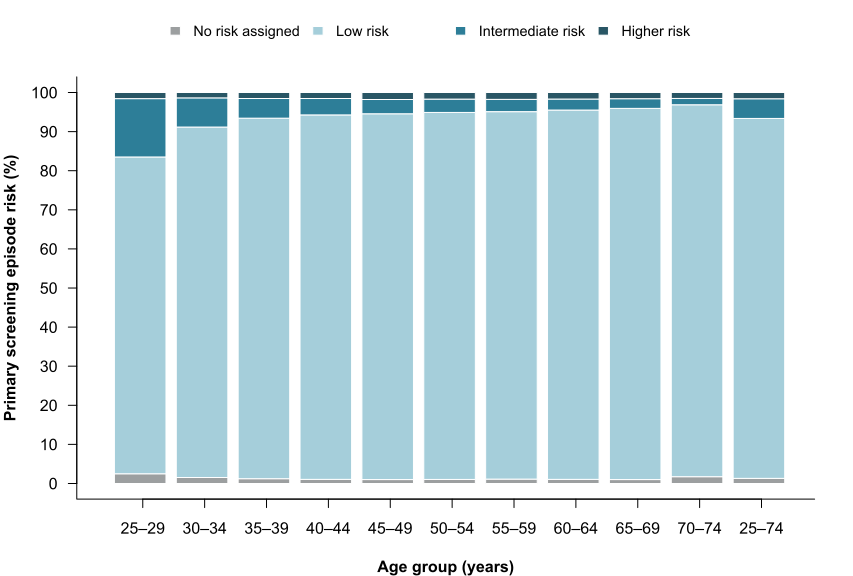
Risk categories for each age group are shown in Figure 4.1.
The proportion of primary screening episodes that were intermediate risk was higher for younger participants. This indicates that, in participants aged less than 35, it was more common that oncogenic HPV (not 16/18) was detected during the screening episode, and that the LBC test result was either negative or low-grade.
For all age groups, the majority of primary screening episodes were low risk. The proportion that were higher risk was consistently low across all age groups.
The proportion of primary screening episodes for which risk could not be assigned was too low to be visible in the figure.
Figure 4.1: Primary screening episode risk, by age, 2024
Source: AIHW analysis of NCSR data (NCSR RDE 11/07/2025). Data and notes for this figure are available in Table A4.1b.
Primary screening episode risk trends
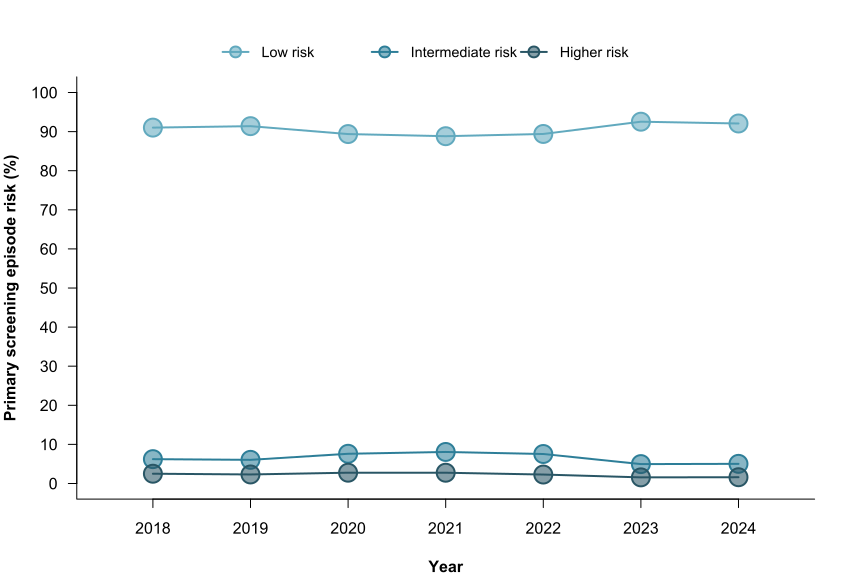
Between 2018 and 2024, there have been only small changes in the proportion of screening episodes that were low risk, intermediate risk, and higher risk.
Risk categories for each year are shown in Figure 4.2.
The proportion of screening episodes that were low risk decreased slightly from around 91% in 2018 and 2019 to just below 90% for the years 2020 to 2022, before increasing slightly to 92.5% in 2023 and 92.1% in 2024. The proportion that were intermediate risk increased slightly from around 6% in 2018 and 2019 to between 7.5% and 8.1% for the years 2020 to 2022, before decreasing to 5.0% in 2023 and 2024. The proportion of screening episodes that were higher risk remained very low at between 2.3% and 2.8% over the years 2018 to 2022, decreasing even further to 1.6% in 2023 and 2024.
This profile of more low risk screening episodes and fewer intermediate risk and higher risk screening episodes in 2024 is likely reflective of the majority of participants in 2024 being participants who are returning 5 years after a previous low risk HPV test, and so are less likely to have an abnormality than in the previous years where many participants were new screeners or under- or never-screeners who are more likely to have an abnormality detected.
Figure 4.2: Primary screening episode risk, by year, participants aged 25–74, 2018 to 2024
Source: AIHW analysis of NCSR data (NCSR RDE 11/07/2025). Data and notes for this figure are available in Table A4.3b.