


Performance Indicator 5: Correlation of screening results
Summary of correlation of screening results data
In 2023, for participants aged 25–74, there were 3,691 primary screening episodes that had an LBC that predicted a high-grade or glandular abnormality or cervical cancer, of which 2,974 (80.6%) were followed by histology within 6 months. Of these 2,974 histology tests, 2,103 (70.7%) had a histology result of high-grade cervical abnormality or cervical cancer.
Correlation of screening results
Definition
Level of agreement between screening results in participants aged 25–74 in a calendar year and subsequent histology test results within 6 months.
Rationale
The correlation between a positive screening test result and the histology test or 'truth' (where this is performed) is a key measure of the accuracy of the HPV test, LBC test,
and overall risk assigned to a screening episode. A histology test involves examination of tissue from the cervix through a microscope and is the primary diagnostic tool of the NCSP.
Data considerations
A complete assessment of the correlation between screening tests results and the 'truth' would have required all cervical screening tests (including negative) to be followed up by histology, but this is neither feasible nor desirable (as it would be unethical to require all participants who had an HPV test to also undergo a biopsy). Rather, this assessment is restricted to cervical screening tests and histology tests available on the NCSR, and is intended to provide measures that can be monitored annually to detect early indications of changes to the correlation between screening tests and histology tests.
These data are restricted to primary screening tests. Histology would usually only be performed following a primary screening test to confirm a suspected abnormality, according to the screening pathway and clinical guidelines. However, it is possible that some of the tests that have been included are not true primary screening tests, but may have been performed for another purpose, such as to investigate signs or symptoms of cervical cancer. In these cases, histology may be an outcome even in the absence of a positive screening test. It is also possible that some participants who have had a primary screening test may have a biopsy or surgical removal of tissue that includes cervical tissue for a benign condition (for example a hysterectomy), unrelated to a primary screening test result.
These data do not include primary screening tests not followed by histology, for which it is not possible to know the true disease state, or primary screening tests followed by histology more than 6 months after the screening test. Where there was more than one histology test within 6 months, the most serious histology result has been used. Risk refers to the risk of significant cervical abnormality for the primary screening test, irrespective of previous tests.
This performance indicator is restricted to histology tests notified by pathology laboratories. The NCSR supplements these data with MBS histology data, but as these do not include a result, they are not able to be included in these data.
In the case that an unsatisfactory LBC test is repeated, the repeat LBC test result is reported in place of the initial unsatisfactory LBC test result.
This performance indicator is based on primary screening tests performed in 2023. This allows 6 months to 30 June 2024 to know whether a histology test occurred, and a further 6 months to 31 December 2024 to ensure that histology data to 30 June 2024 are complete.
Results
A screening test is not intended to be diagnostic, but aims to identify people who are more likely to have a disease and therefore require further investigation from diagnostic tests. These data examine how well the cervical screening test correlates with the histology finding or 'truth', where a histology test has been performed. Correlation between the primary screening test prediction and the histology finding provide valuable information about the accuracy of the screening test of the NCSP.
As stated in the data considerations, a complete assessment of the correlation between screening tests results and the 'truth' would have required all cervical screening tests (including negative tests) to be followed up by histology. This assessment is restricted to cervical screening tests and histology tests available on the NCSR, and is intended to provide measures that can be monitored annually to detect early indications of changes to the correlation between screening tests and histology results.
These data include primary screening tests performed for participants aged 25–74 in 2023 where the test was followed by histology within 6 months (either to confirm the presence or absence of disease, or for other reasons). These data do not include primary screening tests not followed by histology, for which it is not possible to know the true disease state, or primary screening tests followed by histology more than 6 months after the screening test.
In 2023 there were 1,170,114 primary screening HPV tests performed for participants aged 25–74. Of these, 19,787 (1.7%) were followed by a histology test within 6 months.
Key outcomes are shown in Table 5.1 and Table A5.1 and described in the following text.
In these data, there were 1,083,043 primary screening tests that did not detect oncogenic HPV, 9,899 (0.9%) of which had histology performed within 6 months. Primary screening tests that did not detect oncogenic HPV would not usually be followed by histology, so these participants should not be considered indicative of all participants with a primary screening test that did not detect oncogenic HPV, who are primarily at low risk of significant cervical abnormality. Of the 9,899 histology tests performed within 6 months, 9,419 (95.2%) were negative (and thus were likely due to benign conditions unrelated to cervical screening), 170 (1.7%) were low-grade, and 29 (0.3%) were high-grade or cervical cancer.
There were 57,900 primary screening tests that detected oncogenic HPV (not 16/18) for which the reflex LBC result was negative or low-grade (intermediate risk of significant cervical abnormality), 1,191 (2.1%) of which had histology performed within 6 months. Again, these primary screening tests would not usually be followed by histology, so these should not be considered indicative of all participants with this screening test result. Of the 1,191 histology tests performed within 6 months, 710 (59.6%) were negative, 353 (29.6%) were low-grade, and 1,146 (9.7%) were high-grade or cervical cancer.
There were 2,363 primary screening tests that detected oncogenic HPV (not 16/18) for which the reflex LBC result was a high-grade or glandular abnormality or cervical cancer (higher risk of significant cervical abnormality), 1,882 (79.6%) of which had histology performed within 6 months. Of the 1,882 histology tests performed within 6 months, 233 (12.4%) were negative, 376 (20.0%) were low-grade, and 1,264 (67.2%) were high-grade or cervical cancer.
There were 10,886 primary screening tests that detected oncogenic HPV 16/18 for which the reflex LBC result was negative or low-grade (higher risk of significant cervical abnormality), 3,946 (36.2%) of which had histology performed within 6 months. While participants with this primary screening test result are recommended to have a colposcopy, a biopsy will only be performed if an abnormality is visible at colposcopy. Of the 3,946 histology tests performed within 6 months, 1,948 (49.4%) were negative, 1,438 (36.4%) were low-grade, and 500 (12.7%) were high-grade or cervical cancer.
There were 1,315 primary screening tests that detected oncogenic HPV 16/18 for which the reflex LBC result was a high-grade or glandular abnormality or cervical cancer (higher risk of significant cervical abnormality), 1,097 (83.4%) of which had histology performed within 6 months. Of the 1,097 histology tests performed within 6 months, 118 (10.8%) were negative, 141 (12.9%) were low-grade, and 834 (76.0%) were high-grade or cervical cancer.
HPV test result | LBC test result | Number screening tests | Negative histology | Low-grade histology | High-grade or cancer histology |
|---|---|---|---|---|---|
Not detected | Any | 1,083,043 | 9,419 | 170 | 29 |
Not 16/18 | Negative or low-grade | 57,900 | 710 | 353 | 116 |
Not 16/18 | High-grade or glandular | 2,363 | 233 | 376 | 1,264 |
16/18 | Negative or low-grade | 10,886 | 1,948 | 1,438 | 500 |
16/18 | High-grade or glandular | 1,315 | 118 | 141 | 834 |
Note: Numbers do not sum due to the exclusion of histology tests for which there was no valid result.
Source: AIHW analysis of NCSR data (NCSR RDE 11/07/2025).
These findings demonstrate that the LBC result is a good predictor of the histology result.
For primary screening tests performed in 2023, irrespective of HPV test result, 3,691 primary screening tests had an LBC that predicted a high-grade or glandular abnormality or cervical cancer, with 2,974 followed by histology within 6 months. Of these 2,974 histology tests, 2,103 (70.7%) had a histology result of high-grade cervical abnormality or cervical cancer.
Figure 5.1 shows the proportion of each of the histology results of 'Negative', 'Low-grade', 'High-grade' and 'Cancer' that were preceded by an LBC result of 'Negative', 'Low-grade', or 'High-grade+' (high-grade, cancer or glandular).
For the 19,381 histology tests that occurred within 6 months of a primary screening test:
- Negative histology was most frequently preceded by an HPV test that did not detect oncogenic HPV, and hence a reflex LBC was usually not performed. Where LBC was performed, negative histology was most frequently preceded by a negative LBC test.
- Low-grade histology was most frequently preceded by a negative LBC test (37.2%), followed by a low-grade LBC test (22.4%) and then a high-grade+ LBC test (17.2%).
- High-grade histology was most frequently preceded by a high-grade+ LBC test (68.0% of high-grade histology tests were preceded by a high-grade or higher LBC).
- Cervical cancer histology was most frequently preceded by a high-grade+ LBC test (69.7% of cervical cancer histology tests were preceded by a high-grade or higher LBC) (Figure 5.1).
Figure 5.1: Histology performed within 6 months of a primary screening test, by prior LBC test result, participants aged 25–74 screened in 2023
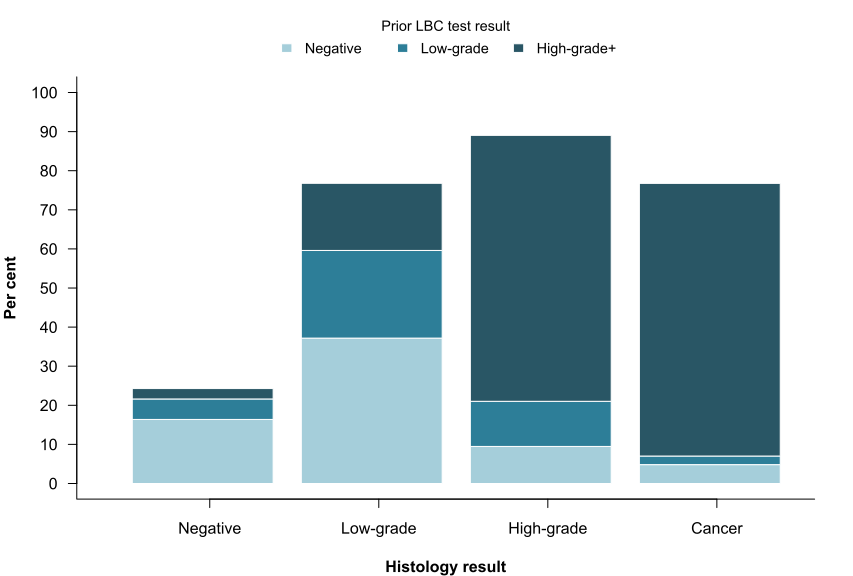
Note: Histology does not equal 100% as cases where LBC was not performed are included in calculations but excluded from this figure.
Source: AIHW analysis of NCSR data (NCSR RDE 11/07/2025). Data and notes for this figure are available in Table A5.1
Correlation of screening results trends
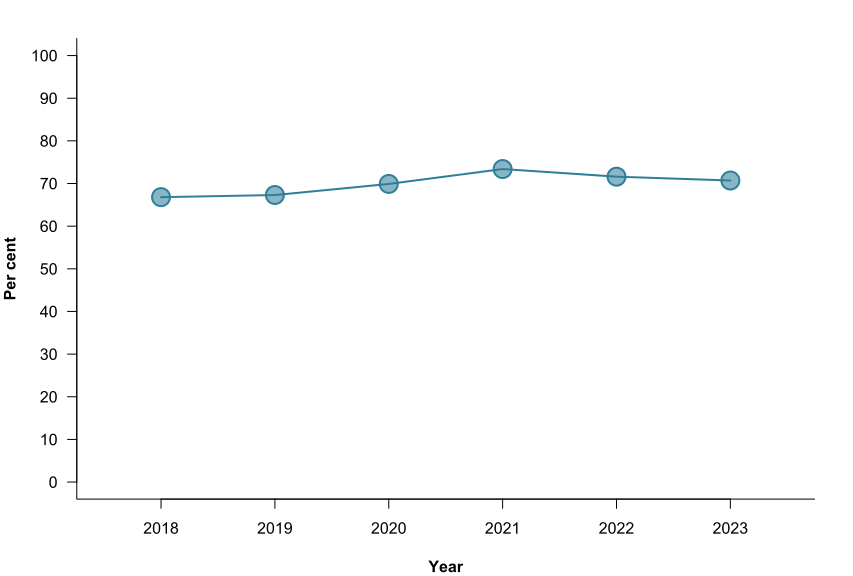
The proportion of primary screening tests that had an LBC that predicted a high-grade or glandular abnormality or cervical cancer followed by histology within 6 months with a result of high-grade cervical abnormality or cervical cancer was 66.8% in 2018, increasing to 67.3% in 2019, to 69.9% in 2020, and to 73.4% in 2021, before decreasing slightly to 71.6% in 2022 and 70.7% in 2023 (Figure 5.2).
Figure 5.2: Proportion of high-grade or glandular LBC tests followed by high-grade cervical abnormality or cervical cancer histology within 6 months, participants aged 25–74, 2018 to 2023
Source: AIHW analysis of NCSR data (NCSR RDE 11/07/2025). Data and notes for this figure are available in Table A5.2.