


Performance Indicator 17b: Cervical cancer detection rate
Summary cervical cancer detection rate data
In 2024, there were 0.5 participants with an incident cervical cancer detected by histology per 1,000 screened, for participants aged 25–74.
Cervical cancer detection rate
Definition
Number of participants aged 25–74 with cervical carcinoma detected on histology in a calendar year per 1,000 participants screened.
Rationale
The cancer detection rate will be measured alongside the high-grade detection rate.
Data considerations
The cancer detection rate measures cervical cancers detected on histology and included in the NCSR. This is different from cervical cancer incidence that uses data from the Australian Cancer Database, sourced from state and territory cancer registries.
The cervical cancer detection rate uses incident cervical cancer cases as the numerator. An incident cervical cancer case is the first histology test for a participant that has cervical cancer as the result. Similar to the high-grade cervical detection rate, the denominator is participants who had an HPV test for any reason.
This performance indicator is restricted to histology tests notified by pathology laboratories.
This performance indicator is a count of participants, not tests.
This performance indicator is based on histology performed in 2024. This allows 6 months to 30 June 2025 to ensure that histology data to 31 December 2024 are complete.
Results
The cervical cancer detection rate is the number of participants with an incident cervical cancer detected by histology per 1,000 participants screened.
In 2024, an incident cervical cancer was detected by histology in 876 participants – 807 of which were aged 25–74. This equates to 0.5 participants with an incident cervical cancer detected by histology per 1,000 participants screened. This means that, for every 1,000 participants screened, fewer than one participant had a cervical cancer detected.
The cervical cancer detection rate of 0.5 per 1,000 participants screened is far lower than the high-grade abnormality detection rate of 7.2 participants with a high-grade abnormality detected per 1,000 screened. This reflects that the aim of cervical screening is not to detect cervical cancer, but to prevent it through the detection of high-grade abnormalities.
Cervical cancer detection rate by age
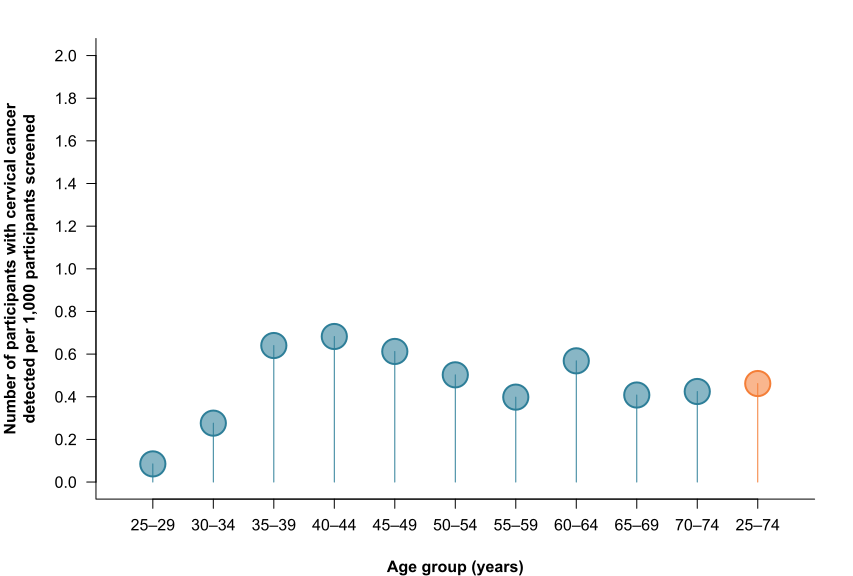
The cervical cancer detection rate was very low for participants aged 25–29 and 30–34, at 0.1 and 0.3 participants with cervical cancer detected by histology per 1,000 participants screened, respectively. Thereafter the cervical cancer detection rate was between 0.4 and 0.7 participants with cervical cancer detected by histology per 1,000 participants screened for participants aged between 35–39 and 70–74 (Figure 17.4).
Figure 17.4: Cervical cancer detection rate, by age, 2024
Source: AIHW analysis of NCSR data (NCSR RDE 11/07/2025). Data and notes for this figure are available in Table A17.6.