


Performance Indicator 19: Incidence of cervical cancer
Summary cervical cancer incidence data
886 women aged 25–74 were diagnosed with cervical cancer in 2021, which is an incidence of 11.0 new cases per 100,000 women.
Progress towards the elimination of cervical cancer
An incidence of fewer than 4 new cases per 100,000 women is the point at which cervical cancer will be considered to be eliminated as a public health problem.
This definition is based on the number of new cases of cervical cancer in females of all ages per 100,000 females in the population, age-standardised to the WHO World 2015 female population.
In 2021, this was 6.2 new cases per 100,000 women.
Incidence of cervical cancer
Definition
Number of new cases of cervical cancer in females aged 25–74 in a calendar year per 100,000 estimated resident population.
Rationale
Incidence data provide contextual information about the number of new cases of cervical cancer in the population that is an indicator of program performance against its aim to reduce cervical cancer through organised screening.
Data considerations
Australia has high-quality and virtually complete cancer incidence data. Collected by state and territory cancer registries, clinical and demographic data for all cancer cases are provided to the AIHW and compiled in the Australian Cancer Database (ACD). Data in this section are sourced from the 2021 version of the ACD.
The 2021 version of the ACD currently contains data on all cases of cancer diagnosed from 1982 to 2021 for all states and territories.
Guide to interpretation
Lower cervical cancer incidence is better.
Results
In 2021, there were 957 new cases of cervical cancer diagnosed in women of all ages, which is 7.4 new cases per 100,000 women in the population (7.1 new cases per 100,000 women after adjusting for age to allow comparison over time or across population groups). Of these, 886 new cases of cervical cancer were diagnosed in women aged 25–74 (the target age group of the NCSP), which is equivalent to 11.0 new cases per 100,000 women aged 25–74 (11.2 new cases per 100,000 women aged 25–74 after adjusting for age to allow comparison over time or across population groups).
Incidence by age
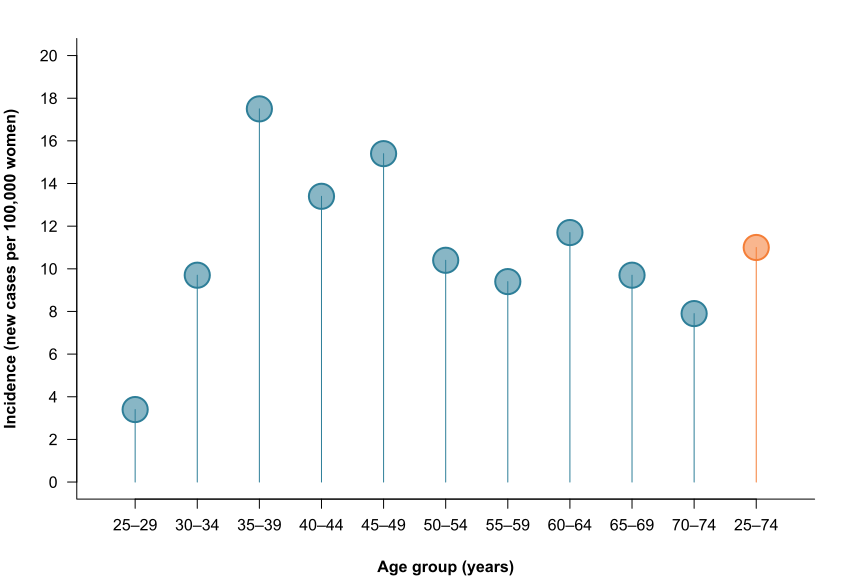
Cervical cancer incidence by age is shown in Figure 19.1.
In 2021, within the age group 25–74, cervical cancer incidence was lowest for women aged 25–29 at 3.4 new cases per 100,000 women. Incidence peaked for women aged 35–39 at 17.5 new cases per 100,000 women.
Figure 19.1: Cervical cancer incidence, by age, 2021
Source: AIHW Australian Cancer Database 2021. Data and notes for this figure are available in Table A19.1.
Incidence by histological type
While all cervical cancers share the site code C53 under the International Statistical Classification of Diseases and Related Health Problems, 10th Revision (ICD-10), there are several histological subtypes within the category of cervical cancer with clear differences in clinical behaviour (Blomfield and Saville 2008). Histology codes for cancers are collected in the ACD, which allows the analysis of trends in cervical cancer incidence for different histological types.
Note that histological groupings for cervical cancer have changed from previous reports, in line with the histology framework for cervical cancer in the December 2024 release of Cancer data in Australia (AIHW 2024). Previous National Cervical Screening Program monitoring reports used the histological groupings for cervical cancer set out in Chapter 4 of Cancer incidence in five continents: vol. IX (Curado et al. 2007). A new histology framework was developed for the ACD, with these histology groupings used for the first time in this report.
In 2021, of the 886 cervical cancers diagnosed in women aged 25–74, 871 (98.3%) were carcinomas, 1 (0.1%) was a melanoma, 5 (0.6%) were sarcomas, 3 (0.3%) were other cancers, and 6 (0.7%) were unclassifiable cancers (Table 19.1).
Type of cervical cancer | New cases | Crude rate | AS rate | % cervical cancers | % carcinomas |
|---|---|---|---|---|---|
1: Carcinomas | 871 | 10.8 | 11.0 | 98.3 | . . |
1.1: Squamous cell carcinomas | 605 | 7.5 | 7.6 | 68.3 | 69.5 |
1.2: Adenocarcinomas | 230 | 2.8 | 3.0 | 26.0 | 26.4 |
1.3: Adenosquamous carcinomas | 6 | 0.1 | 0.1 | 0.7 | 0.7 |
1.4: Carcinosarcomas | 3 | 0.0 | 0.0 | 0.3 | 0.3 |
1.5: Neuroendocrine neoplasms | 11 | 0.1 | 0.1 | 1.2 | 1.3 |
1.6: Other and unclassifiable carcinomas | 16 | 0.2 | 0.2 | 1.8 | 1.8 |
2: Melanomas | 1 | 0.0 | 0.0 | 0.1 | . . |
3: Sarcomas | 5 | 0.1 | 0.1 | 0.6 | . . |
4: Other cancers | 3 | 0.0 | 0.0 | 0.3 | . . |
5: Unclassifiable cancers | 6 | 0.1 | 0.1 | 0.7 | . . |
Total | 886 | 11.0 | 11.2 | 100.0 | . . |
'Carcinomas' = International Classification of Diseases for Oncology, Third Edition, Second Revision (ICD-O-3.2) histology codes 8010, 8012, 8013, 8015, 8020–8022, 8030, 8033, 8041, 8045, 8050–8052, 8070–8076, 8082–8086, 8098, 8140, 8141, 8143, 8144, 8200, 8240, 8244, 8246, 8249, 8255, 8260, 8262, 8263, 8310, 8313, 8323, 8380, 8384, 8430, 8441, 8460, 8461, 8474, 8480, 8481, 8482, 8483, 8484, 8490, 8560, 8570, 8574, 8950, 8951, 8980, 9110.
'Squamous cell carcinomas' = ICD-O-3.2 histology codes 8051, 8052, 8070–8076, 8082–8086.
'Adenocarcinomas' = ICD-O-3.2 histology codes 8140, 8141, 8143, 8144, 8200, 8255, 8260, 8262, 8263, 8310, 8313, 8323, 8380, 8384, 8441, 8460, 8461, 8474, 8480, 8481, 8482, 8483, 8484, 8490, 8570, 8574, 9110.
'Adenosquamous carcinomas' = ICD-O-3.2 histology code 8560.
'Carcinosarcomas' = ICD-O-3.2 histology codes 8950, 8951, 8980.
'Neuroendocrine neoplasms' = ICD-O-3.2 histology codes 8013, 8041, 8045, 8240, 8244, 8246, 8249.
'Other and unclassifiable carcinomas' = ICD-O-3.2 histology codes 8010, 8012, 8015, 8020–8022, 8030, 8033, 8050, 8098, 8430.
'Melanomas' = ICD-O-3.2 histology codes 8720, 8730, 8746, 8772.
'Sarcomas' = ICD-O-3.2 histology codes 8714, 8800, 8801, 8805, 8890, 8891, 8896, 8900, 8910, 8935, 9133, 9540, 9581.
'Other cancers' = ICD-O-3.2 histology codes 8933, 9105.
'Unclassifiable cancers' = ICD-O-3.2 histology codes 8000, 8002.
Note: Crude rate is the number of new cases of cervical cancer per 100,000 women. Age-standardised (AS) rate is the number of new cases of cervical cancer per 100,000 women, age-standardised to the Australian population as at 30 June 2001. Rates based on fewer than 20 new cases should be interpreted with caution. Numbers may not add to total due to rounding.
Source: AIHW Australian Cancer Database 2021.
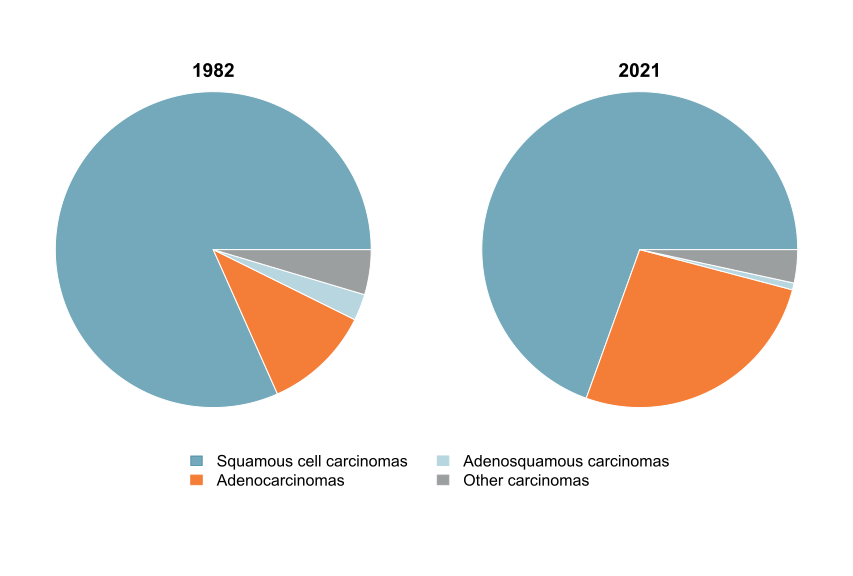
The proportion of each histological type of cervical carcinoma diagnosed in 2021 (the latest year) and 1982 (the first year of data, and before the commencement of the NCSP in 1991) are shown in Figure 19.2. For this comparison, carcinosarcomas, neuroendocrine neoplasms, and other and unclassifiable carcinomas are grouped together into a single 'Other carcinomas' category. In 2021, squamous cell carcinomas comprised 69.5% of all cervical carcinomas, followed by adenocarcinomas at 26.4% and adenosquamous carcinomas at 0.7%. Other carcinomas made up the remaining 3.4%.
This is in contrast to 1982, when squamous cell carcinomas comprised 81.5% of all cervical carcinomas, with adenocarcinomas far rarer at 11.0%. Adenosquamous carcinomas in 1982 comprised 2.7% of carcinomas, while other carcinomas made up the remaining 4.6%.
Figure 19.2: Cervical cancer incidence, by histological type, women aged 25–74, 1982 and 2021
Source: AIHW Australian Cancer Database 2021.
The NCSP has been successful in preventing squamous cell carcinomas by detecting high-grade squamous abnormalities, these being readily identified by repeated cervical cytology (Blomfield and Saville 2008). As a result, squamous cell carcinomas now comprise around 68% of cervical cancers, which is much reduced from their historical proportion of 95% (Blomfield and Saville 2008). In contrast, adenocarcinomas have not been reduced by cervical screening to the same degree. These glandular carcinomas were proportionately a rarer disease, but now comprise 26% of all cervical cancers, not because there are more adenocarcinomas, but because there are fewer squamous cell carcinomas, which has had the effect of reducing the size of the 'pool' of cervical cancers.
Incidence by remoteness area
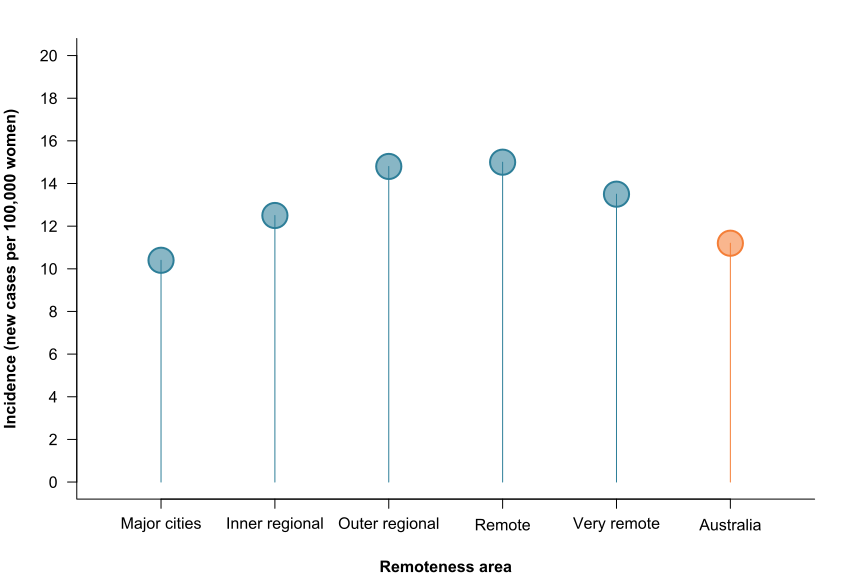
In 2017–2021, cervical cancer incidence for women aged 25–74 increased with increasing remoteness.
After adjusting for age, incidence of cervical cancer in women aged 25–74 in 2017–2021 was lowest for women residing in Major cities at 10.4 new cases per 100,000 women, followed by women residing in Inner regional areas at 12.5 new cases per 100,000. Incidence was highest for women residing in Outer regional, Remote, and Very remote areas, at 14.8, 15.0, and 13.5 new cases per 100,000 women, respectively (Figure 19.3).
Figure 19.3: Cervical cancer incidence, by remoteness area, women aged 25–74, 2017–2021
Source: AIHW Australian Cancer Database 2021. Data and notes for this figure are available in Table A19.3.
Incidence by socioeconomic area
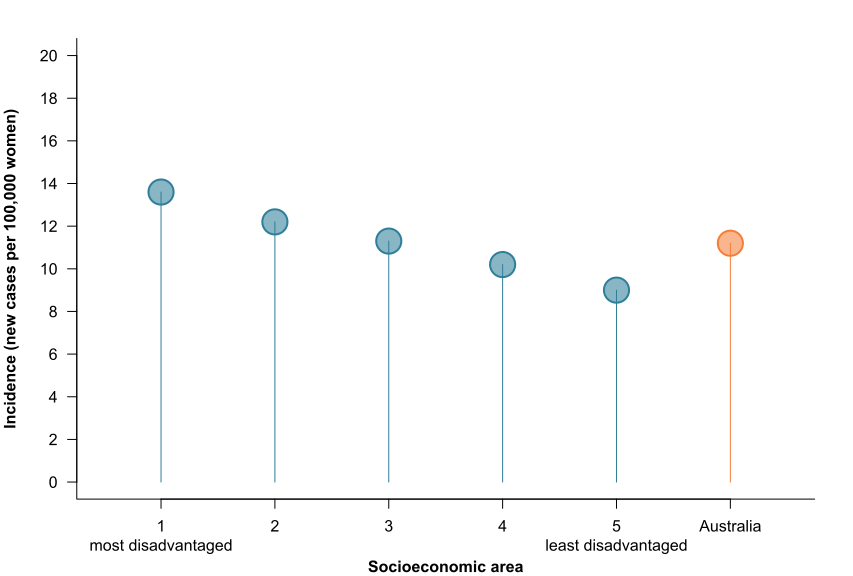
In 2017–2021, cervical cancer incidence for women aged 25–74 increased with increasing socioeconomic disadvantage.
After adjusting for age, cervical cancer incidence in women aged 25–74 was lowest for women residing in areas of lowest socioeconomic disadvantage at 9.0 new cases per 100,000 women; thereafter, it increased with increasing socioeconomic disadvantage and was highest for women residing in areas of highest socioeconomic disadvantage at 13.6 new cases per 100,000 women (Figure 19.4).
Figure 19.4: Cervical cancer incidence by socioeconomic area, women aged 25–74, 2017–2021
Source: AIHW Australian Cancer Database 2021. Data and notes for this figure are available in Table A19.4.
Incidence trends
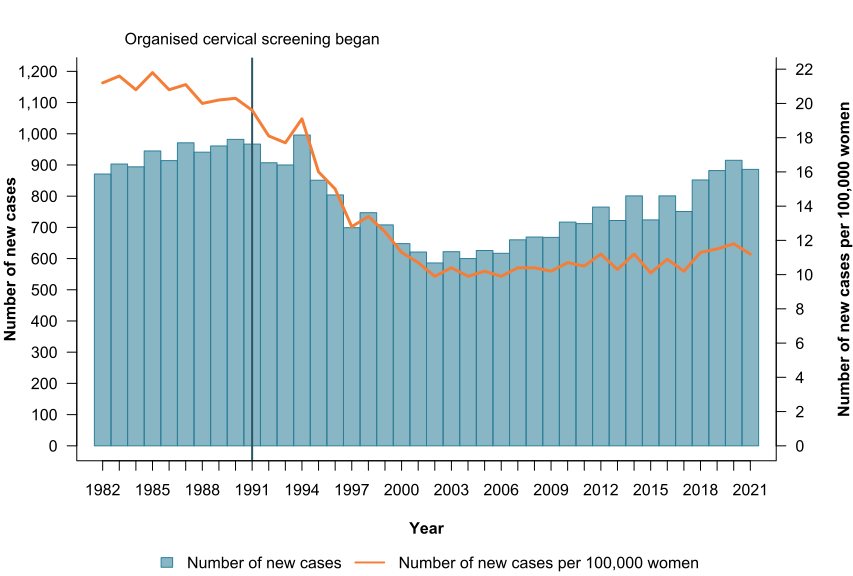
After adjusting for age, there was a modest decrease in the incidence of cervical cancer for women aged 25–74 between 1982 and 1990, from 21.2 to 20.3 new cases per 100,000 women. This is likely to have been a result of the ad-hoc cervical screening that occurred in Australia from the 1960s to 1990. However, it was with the introduction of organised cervical screening through the NCSP in 1991 that the greatest decreases in incidence occurred, with a rapid decrease to 9.9 new cases per 100,000 women in 2002, just over a decade after the national program commenced (Figure 19.5).
The trend for women aged 20–69, the target age group for the NCSP from 1991 to 2017, mirrors this trend for women aged 25–74, the current target age group for the NCSP.
Trends for women aged 25–74 and women of all ages are shown in Table A19.5.
Between 2002 and 2021:
- Incidence remained steady for women aged 25–74, at between 10 and 11 new cases per 100,000 women, with a slight upturn to 11.8 new cases per 100,000 women in 2020, followed by a slight downturn to 11.2 new cases per 100,000 women in 2021.
- Incidence remained steady for females of all ages at around 7 new cases per 100,000 females. The age-standardised incidence rate was 7.5 new cases per 100,000 females in 2020, with a slight downturn to 7.1 new cases per 100,000 women in 2021.
The decrease in incidence over time, which has been attributed to the NCSP, has been accompanied by a decrease in the ranking of cervical cancer – from the sixth most common cancer in women in 1982 to the 12th most common in 2021 – and a decrease in the risk of diagnosis before age 85 from 1 in 74 in 1982 to 1 in 165 in 2021 (AIHW 2025a).
Figure 19.5: Cervical cancer incidence, by year, women aged 25–74, 1982 to 2021
Note: Age-standardised rate is the number of new cases of cervical cancer per 100,000 women, age-standardised to the Australian population as at 30 June 2001.
Source: AIHW Australian Cancer Database 2021. Data and notes for this figure are available in Table A19.5.
These changes are consistent with the introduction of organised cervical screening programs internationally; however, cervical cancer remains one of the most common cancers in women in countries that do not have organised cervical screening, and fourth overall, so the worldwide burden is still high (IARC 2014), even with successes such as those in Australia.
Box 19.1: Progress towards the elimination of cervical cancer
An incidence of fewer than 4 new cases per 100,000 women is the point at which cervical cancer will be considered to be eliminated as a public health problem.
This definition is based on the number of new cases of cervical cancer in females of all ages per 100,000 females in the population, age-standardised to the WHO World 2015 female population.
Over the latest ten years, cervical cancer incidence calculated in this way decreased from 6.7 new cases per 100,000 women in 2012 to a low of 5.9 new cases per 100,000 women in 2017. It then increased after the introduction of the renewed NCSP to 6.5 in 2018 and 2019, and 6.6 new cases per 100,000 women in 2020.
In 2021, the latest year of data, incidence had fallen to 6.2 new cases per 100,000 women, age-standardised to the WHO World 2015 female population.
These data are available in Table A19.5.
Survival from cervical cancer
Survival in this report refers to 'relative survival', which is the probability of being alive for a given amount of time after diagnosis compared with the general population, and reflects the impact of a cancer diagnosis. The source of survival data is the 2021 Australian Cancer Database which includes data from the National Death Index on deaths (from any cause) that occurred up to 31 December 2021, which were used to determine which people with cancer had died and when this occurred.
In 2017–2021, women diagnosed with cervical cancer in Australia had a 76.8% chance of surviving for 5 years compared with their counterparts in the general population. For the target age group for the NCSP of 25–74, 5-year survival was 80.0%.
Five-year relative survival by age
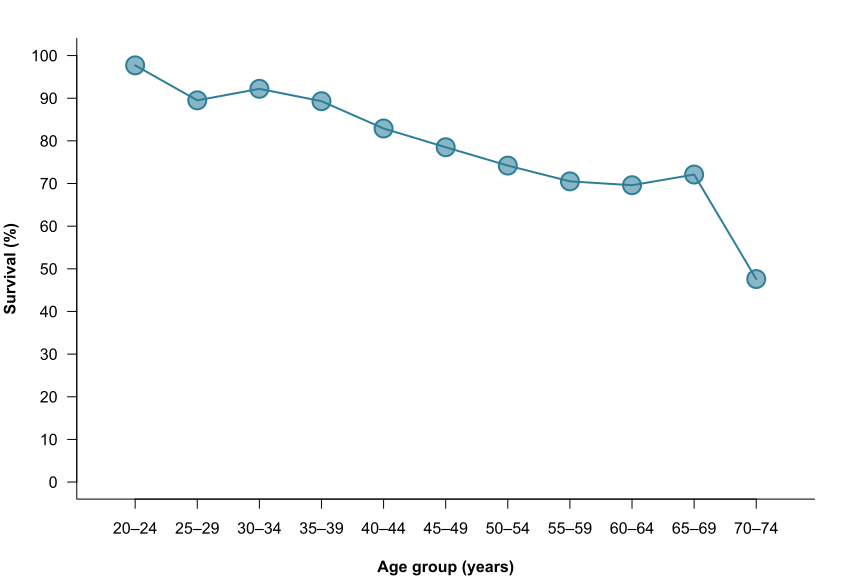
Five-year relative survival from cervical cancer generally decreased in increasing age groups; women aged 20–24 had the highest relative survival at 97.7%, whereas women aged 70–74 diagnosed with cervical cancer had relative survival of only 47.6% (Figure 19.6).
Figure 19.6: Five-year relative survival from cervical cancer, by age, 2017–2021
Source: AIHW Australian Cancer Database 2021. Data and notes for this figure are available in Table A19.6.
Five-year relative survival trends
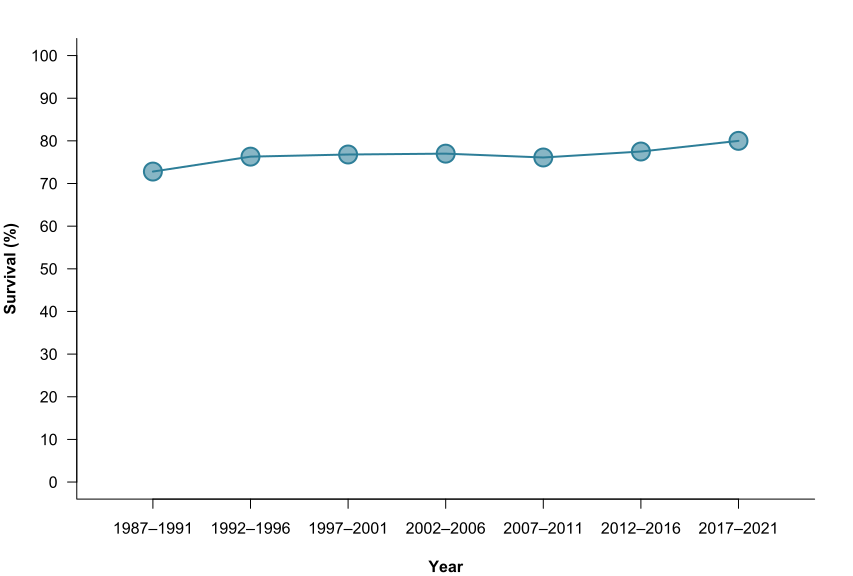
Between 1987–1991 and 2017–2021, 5-year relative survival increased from 72.8% to 80.0% for women aged 25–74 (Figure 19.7).
Figure 19.7: Trends in 5-year relative survival from cervical cancer in women aged 25–74, 1987–1991 to 2017–2021
Source: AIHW Australian Cancer Database 2021. Data and notes for this figure are available in Table A19.7.
Conditional survival
Conditional survival is the probability of surviving a given number of years, provided that an individual has already survived a specified amount of time after diagnosis.
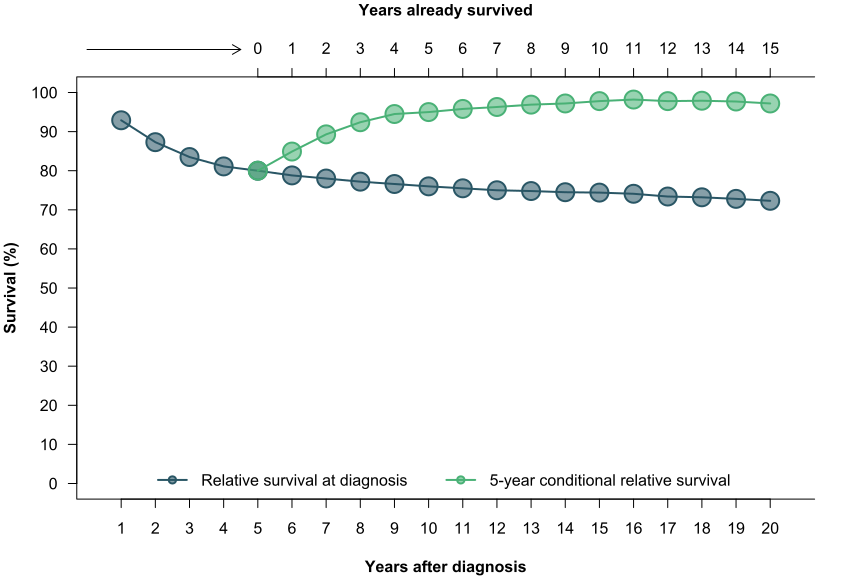
Conditional survival for cervical cancer for women aged 25–74 is illustrated in Figure 19.8.
In this graph, the darker blue line shows relative survival for each year after diagnosis (as shown by the numbers in black on the x-axis); the lighter blue line shows relative survival for each year once an individual has already survived a certain number of years (as shown by the numbers in grey on the x-axis).
For cervical cancer, 5-year conditional survival – the prospect of surviving for at least 5 more years after having already survived for 5 years – was much higher than relative survival, at 95% (Figure 19.8), indicating that if a woman survives for at least 5 years after diagnosis, her chance of survival is almost the same as a woman not diagnosed with cervical cancer.
Figure 19.8: Relative survival at diagnosis and 5-year conditional survival from cervical cancer in women aged 25–74, 2017–2021
Source: AIHW Australian Cancer Database 2021. Data and notes for this figure are available in Table A19.8.
Prevalence of cervical cancer
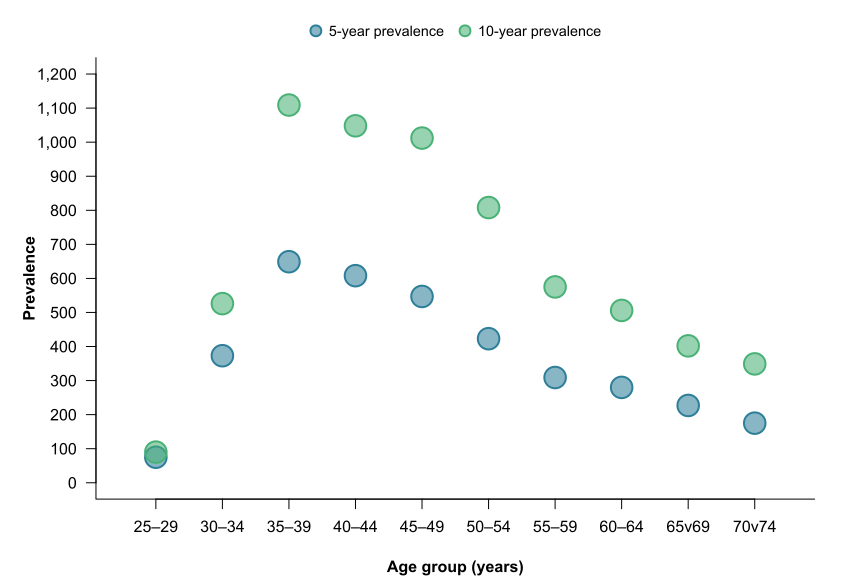
Prevalence is the number of people alive after a diagnosis of cancer. It is related to incidence and survival; if incidence and survival are both high, prevalence will be high, whereas if incidence and survival are both low, prevalence will be low.
The source of prevalence data is the 2021 Australian Cancer Database which includes data from the National Death Index on deaths (from any cause) that occurred up to 31 December 2021, which were used to determine which people with cancer had died and when this occurred. Individuals who have been diagnosed with cancer and are still alive contribute to prevalence data.
At the end of 2021, there were 3,666 women aged 25–74 alive who had been diagnosed with cervical cancer in the previous 5 years and 6,425 who had been diagnosed in the previous 10 years (Figure 19.9).
Figure 19.9: Prevalence of cervical cancer, by age, end of 2021
Source: AIHW Australian Cancer Database 2021.