


Performance Indicator 9: Colposcopy in self-collection participants
Summary data for participants who have a colposcopy after a self-collected sample in which oncogenic HPV 16/18 is detected
In 2024, of the 9,371 participants aged 25–74 who self-collected and whose HPV test was positive for oncogenic HPV 16/18, 61.0% had a colposcopy within 3 months and 80.3% had a colposcopy within 6 months.
Colposcopy in self-collection participants positive for oncogenic HPV 16/18
Definition
Percentage of participants aged 25–74 who have a colposcopy after a self-collected screening HPV test positive for oncogenic HPV 16/18 in a calendar year.
Rationale
Participants who self-collect and who test positive for oncogenic HPV 16/18 are recommended to have a colposcopy within 8 weeks. This indicator monitors compliance with this recommendation within 3 months, and within 6 months, by which time it is considered that most participants would have been able to attend an appointment with a colposcopist.
Guide to interpretation
A higher percentage is better.
Data considerations
If the HPV test result detects oncogenic HPV 16/18, the participant is considered higher risk and referred for colposcopy. Any colposcopy or histology test performed within 3 months or within 6 months is included, as a histology test is an indication of a colposcopy.
Under the renewed NCSP, prior to 1 July 2022, when all participants became eligible for self-collection, only those aged 30 or over who had never participated in cervical screening or were 2 years or more overdue for cervical screening were eligible to self-collect a vaginal sample for their HPV test. This means that the data for 2022 will comprise 6 months where self-collection was restricted and 6 months where self-collection was not restricted.
Time to colposcopy is calculated from the date the self-collected HPV test was performed, not the date the participant received a referral to colposcopy. This means the reported rate is likely lower than if date of referral to colposcopy was used instead of date of self-collected HPV test.
This performance indicator is based on primary screening tests performed in 2024. This allows 6 months to 30 June 2025 to know whether a colposcopy or histology occurred. However, the further 6 months to 31 December 2025 to ensure that colposcopy and histology data to 30 June 2025 are complete has not been applied in the interest of reporting the most up-to-date self-collection data available. This means that the data for 2024 could be an underestimate, and the true proportion of these participants having colposcopy within 6 months may be higher than is reported here.
Results
In 2024, there were 9,371 participants aged 25–74 who self-collected a sample for their primary screening HPV test and were found to be positive for oncogenic HPV 16/18. Of these 9,371 participants, 61.0% had a colposcopy within 3 months and 80.3% had a colposcopy within 6 months of their primary screening HPV test.
Colposcopy in self-collection participants positive for oncogenic HPV 16/18 by age
The proportion of participants who self-collected a sample for their primary screening HPV test that detected oncogenic HPV 16/18 who had a colposcopy within 3 months was highest for participants aged 50–54 at 65.4%, and lowest for participants aged 25–29 at 48.1% (Figure 9.1).
The proportion who had a colposcopy within 6 months was highest for participants aged 50–54 at 84.0%, and lowest for participants aged 25–29 at 65.5% (Figure 9.1).
Figure 9.1: Proportion of participants who self-collected a sample for their primary screening HPV test that detected oncogenic HPV 16/18 who had a colposcopy within 3 months and within 6 months, by age, 2024

Source: AIHW analysis of NCSR data (NCSR RDE 11/07/2025). Data and notes for this figure are available in Table A9.1a and Table 9.1b.
Colposcopy in self-collection participants positive for oncogenic HPV 16/18 trends
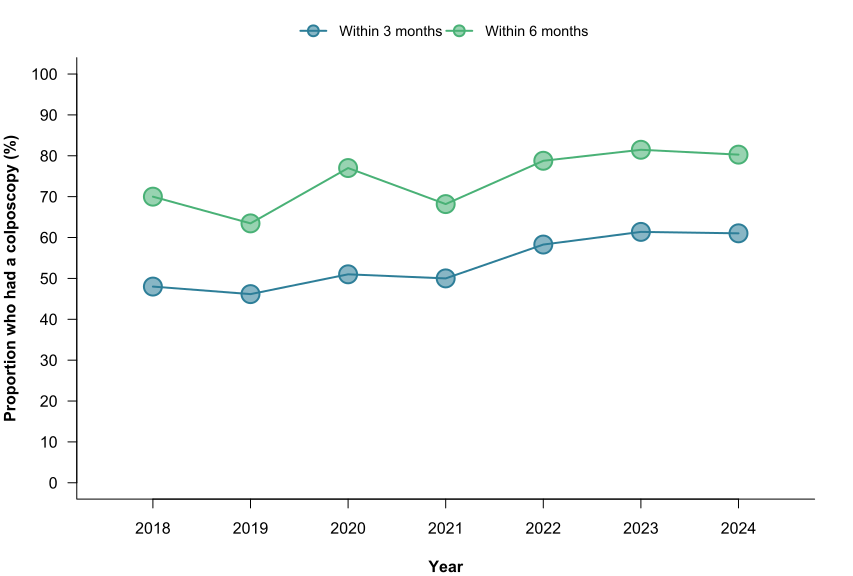
The proportion of participants who self-collected a sample for their primary screening HPV test that detected oncogenic HPV 16/18 and who had a colposcopy within 3 months and within 6 months increased in 2022 and increased again in 2023 and 2024 (note that the number of participants who self-collected a sample in 2018 was very low, so data for this year are not as robust as later years).
For participants who had a colposcopy within 3 months, this increase was from 50.0% in 2021 to 58.3% in 2022, and to 61.4% in 2023 and 61.0% in 2024 (Figure 9.2).
For participants who had a colposcopy within 6 months, this increase was from 68.2% in 2021 to 78.8% in 2022, and to 81.5% in 2023 and 80.3% in 2024 (Figure 9.2).
The high proportion of participants who self-collected a sample for their primary screening HPV test that detected oncogenic HPV 16/18 and who had a colposcopy within 3 months and within 6 months in 2022, 2023, and 2024 may be a result of the change in the self-collection policy from July 2022, which allowed routine screeners to self-collect their sample.
These data suggest that routine screeners selecting a self-collected sample over practitioner-collected sample are more likely to have a colposcopy when they have a higher risk HPV test result than under- or never-screened participants.
There may also be factors related to availability of colposcopy appointments that facilitate participants accessing colposcopy within 3 or 6 months after a higher risk HPV test result.
Figure 9.2: Proportion of participants who self-collected a sample for their primary screening HPV test that detected oncogenic HPV 16/18 who had a colposcopy within 3 months and within 6 months, participants aged 25–74, 2018 to 2024
Source: AIHW analysis of NCSR data (NCSR RDE 11/07/2025). Data and notes for this figure are available in Table A9.2a and Table A9.2b.