


Performance Indicator 3: Rescreening
Summary of rescreening data
39.9% of participants aged 25–69 whose screening HPV test in 2018 did not detect oncogenic HPV rescreened on time (between 4 years 9 months and 5 years 3 months after their screen in 2018).
Rescreening
Definition
Percentage of participants aged 25–69 whose screening HPV test in the index calendar year did not detect oncogenic HPV who rescreened within a specified period of time.
Rationale
The proportion of the target population screened within the recommended screening interval is a key determinant of the success of a screening program; screening more frequently increases costs with minimal or no gain in a reduction in incidence and mortality; screening less frequently results in a decrease in overall participation in screening and means that fewer precancerous abnormalities can be detected and treated, necessary for achieving the overall aim of reducing incidence and mortality from cervical cancer. This indicator measures the proportion of participants who rescreened early, appropriately, or late.
Note that although the National Cervical Screening Program target age group is 25–74, only participants aged 25–69 are reported for rescreening because participants aged 70–74 at the time of their screen would be outside the target age group of 25–74 when they are due for their 5-year rescreen.
Guide to interpretation
For those participants recommended to rescreen in 5 years, a higher rescreen rate between 4 years 9 months and 5 years 3 months (considered rescreening 'on time') is better.
Data considerations
More than 5 years need to have passed since the inception of the renewed NCSP to allow this performance indicator to be measured as per the definition.
Rescreening categories are:
Early rescreening (within 4 years 9 months)
Adequate rescreening: on time (between 4 years 9 months and 5 years 3 months)
Adequate rescreening: overdue (between 5 years 3 months and 6 years)
Late rescreening (more than 6 years)
This performance indicator is based on primary screening tests performed in 2018.
This allows 6 years and 6 months to 30 June 2025 to know if a participant rescreened within that time. This allows calculation of the proportion of participants who rescreened early, on time, and overdue, but not complete calculation of the proportion of participants who rescreened late, as there are some participants who have not yet rescreened, but may in future when more follow-up data are available, who would contribute to late rescreening.
Results
In 2018, there were 1,398,326 participants aged 25–69 with screening HPV test that did not detect oncogenic HPV, who were recommended to rescreen in 5 years.
Of these participants:
- 16.1% rescreened within 4 years 9 months (early rescreening)
- 39.9% rescreened between 4 years 9 months and 5 years 3 months (adequate rescreening: on time)
- 16.1% rescreened between 5 years 3 months and 6 years (adequate rescreening: overdue)
- 7.0% rescreened more than 6 years after their screen in 2018 (late rescreening)
- 20.9% had not rescreened as at 30 June 2025 (6.5 years after the end of 2018).
While it is too soon to know how many participants rescreened late, enough time has passed since the end of 2018 to determine the proportion of participants with a screening HPV test in 2018 that did not detect oncogenic HPV who rescreened early or adequately (either on time or overdue).
Most participants rescreened adequately – 39.9% adequately and on time, and 16.1% adequately but overdue. Combined this was 55.9% of participants aged 25–69 with a screening HPV test that did not detect oncogenic HPV in 2018 that rescreened within an adequate length of time (Table 3.1).
Early rescreening | Adequate rescreening: on time | Adequate rescreening: overdue | Late rescreening† | No rescreening |
|---|---|---|---|---|
225,268 | 557,481 | 224,765 | 98,224 | 292,588 |
16.1% | 39.9% | 16.1% | 7.0% | 20.9% |
† Not enough time has passed to accurately calculate late rescreening; both late screening and no rescreening are as at 30 June 2025, which is only 6.5 years since the end of the index year 2018.
Note: Early rescreening = rescreening within 4 years 9 months, adequate rescreening: on time = rescreening between 4 years 9 months and 5 years 3 months, adequate rescreening: overdue = rescreening between 5 years 3 months and 6 years, late rescreening = rescreening more than 6 years after index test.
Source: AIHW analysis of NCSR data (NCSR RDE 11/07/2025).
Rescreening by age
Of those who rescreened on time, rescreening increased with age, with the highest rescreening rates seen in those aged 55–59 and 60–64 in 2018, at 50.0% and 52.7%, respectively. In contrast, rescreening decreased with age for those who rescreened early or were screened when they were overdue (Figure 3.1).
Figure 3.1: Rescreening by age, participants aged 25–69 in 2018
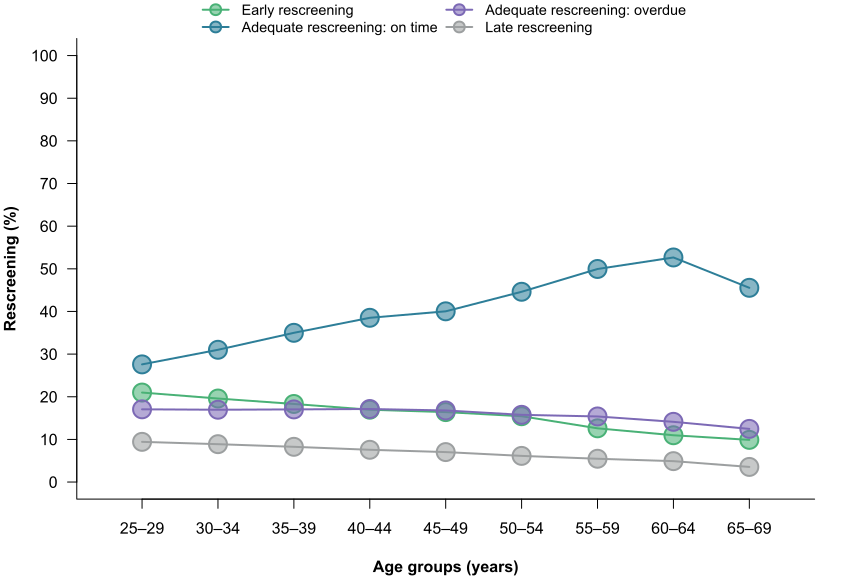
Note: Early rescreening = rescreening within 4 years 9 months, adequate rescreening: on time = rescreening between 4 years 9 months and 5 years 3 months, adequate rescreening: overdue = rescreening between 5 years 3 months and 6 years, late rescreening = rescreening more than 6 years after index test.
Source: AIHW analysis of NCSR data (NCSR RDE 11/07/2025). Data and notes for this figure are available in Table A3.1.