


Performance Indicator 15: Yield of high-grade abnormalities on biopsy
Summary data on yield of high-grade abnormalities on biopsy among participants who attend colposcopy after higher risk screening results
Of the participants aged 25–74 who had a colposcopy in 2023 following a higher risk screening or follow-up result, 17.9% had a high-grade abnormality or cervical cancer detected on histology within 6 months of the colposcopy.
Yield of high-grade abnormalities on biopsy among participants who attend colposcopy after higher risk screening results
Definition
Percentage of participants aged 25–74 with a higher risk screening or follow-up episode result who had a colposcopy in a calendar year who were diagnosed with a high-grade abnormality or cervical cancer on histology within 6 months of colposcopy.
Rationale
As participants who are referred to colposcopy are at higher risk of significant cervical abnormality, it is expected that a proportion of these will be diagnosed with a high-grade abnormality or cervical cancer. This indicator can be used as a measure of the accuracy of colposcopy in identifying and sampling a high-grade abnormality or cervical cancer that is present.
Data considerations
Colposcopy data in the NCSR come from several sources. One source is the colposcopy form, which includes information on the colposcopy itself. While colposcopy data are also sourced from MBS, this level of information is not available for colposcopies for which MBS is the only data source. Therefore, the yield of high-grade abnormalities on biopsy among participants who attend colposcopy after higher risk screening results is calculated using only colposcopies for which the source of data is a colposcopy form.
This indicator looks at yield of high-grade abnormalities on biopsy among participants who attend colposcopy after higher risk results. Prior to 1 February 2021, there were three groups of higher risk participants – two based on primary screening episode results and one based on the follow-up HPV test performed 12 months following an intermediate risk primary screening episode.
Since 1 February 2021, there are four groups of higher risk participants – the same two based on primary screening episode results, one based on the first follow-up screening episode results (including those that would otherwise be intermediate risk but are assigned to higher risk due to being under-screened, Aboriginal and/or Torres Strait Islander, or aged 50 or over), and one based on the second follow-up screening episode.
This performance indicator is based on colposcopies performed in 2023. This allows 6 months to 30 June 2024 to know if they were diagnosed with a high-grade abnormality or cervical cancer within 6 months, and a further 6 months to 31 December 2024 to ensure that histology data to 30 June 2024 are complete.
Results
The yield of high-grade abnormalities on biopsy includes all colposcopies performed after a higher risk screening or follow-up test. Of the participants aged 25–74 who had a colposcopy in 2023 following a higher risk screening or follow-up result, 17.9% had a high-grade abnormality or cervical cancer detected on histology within 6 months of the colposcopy.
This differed according to the higher risk screening or follow-up result that preceded the colposcopy. The yield of high-grade abnormalities on biopsy was highest for participants whose primary screening HPV test detected oncogenic HPV (not 16/18) and whose LBC test result was a high-grade squamous abnormality, squamous cell carcinoma, or a glandular abnormality at 62.9%.
The yield of high-grade abnormalities on biopsy was lower for the other three higher risk groups, at 14.0%, 15.5%, and 12.7% (Table 15.1).
Screening or follow-up result | Number | Yield (%) |
|---|---|---|
Primary screening test HPV 16/18 + any LBC | 1,676 | 14.0 |
Primary screening test HPV (not 16/18) + high-grade/glandular LBC | 1,343 | 62.9 |
First follow-up test HPV 16/18 + any LBC or HPV (not 16/18) + high-grade/glandular LBC | 590 | 15.5 |
Second follow-up test any HPV + any LBC | 970 | 12.7 |
Total | 4,579 | 17.9 |
Source: AIHW analysis of NCSR data (NCSR RDE 11/07/2025).
These results demonstrate that the LBC test result when oncogenic HPV is detected is likely to affect the yield of high-grade abnormalities on biopsy. This is shown in Table 15.2, with the yield of high-grade abnormalities on biopsy for each squamous and endocervical LBC test result from the higher risk screening or follow-up test that preceded the colposcopy shown. Yield was found to increase with increasing severity of abnormality, and was highest at 89.8% for LBC test results of squamous cell carcinoma, and 83.3% for LBC test results of adenocarcinoma in situ or adenocarcinoma (Table 15.2).
LBC test result | Number | Yield (%) |
|---|---|---|
S1 negative | 571 | 5.1 |
S2 possible low-grade squamous intraepithelial lesion | 277 | 10.4 |
S3 low-grade squamous intraepithelial lesion | 434 | 14.7 |
S4 possible high-grade squamous intraepithelial lesion | 1,221 | 52.3 |
S5 high-grade squamous intraepithelial lesion | 1,231 | 79.7 |
S6 or S7 high-grade squamous intraepithelial lesion with possible invasion or squamous cell carcinoma | 97 | 89.8 |
E2 atypical endocervical cells of uncertain significance | 51 | 56.0 |
E3 possible high-grade endocervical glandular lesion | 30 | 75.0 |
E4, E5, or E6 adenocarcinoma in situ, adenocarcinoma in situ with possible invasion, or adenocarcinoma | 35 | 83.3 |
Note: This table includes each squamous and endocervical result in isolation, not as a pair, so where there is a high-grade abnormality or cervical cancer within 6 months of a negative squamous result, there may have been a glandular abnormality in the endocervical result.
Source: AIHW analysis of NCSR data (NCSR RDE 11/07/2025).
Yield of high-grade abnormalities by age
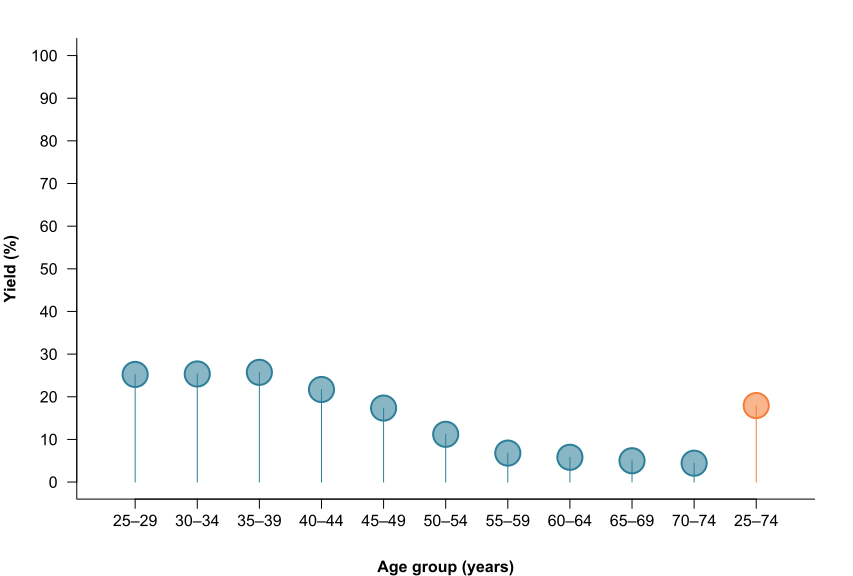
The yield of high-grade abnormalities on biopsy among participants who attend colposcopy after higher risk screening results is shown by age in Figure 15.1. This was above 25% for younger participants, dropping for participants aged 40 and over to reach a low of 4.4% for participants aged 70–74.
Figure 15.1: Yield of high-grade abnormalities on biopsy among participants who attend colposcopy after higher risk screening results, by age, 2023
Source: AIHW analysis of NCSR data (NCSR RDE 11/07/2025). Data and notes for this figure are available in Table A15.1.
Yield of high-grade abnormalities trends
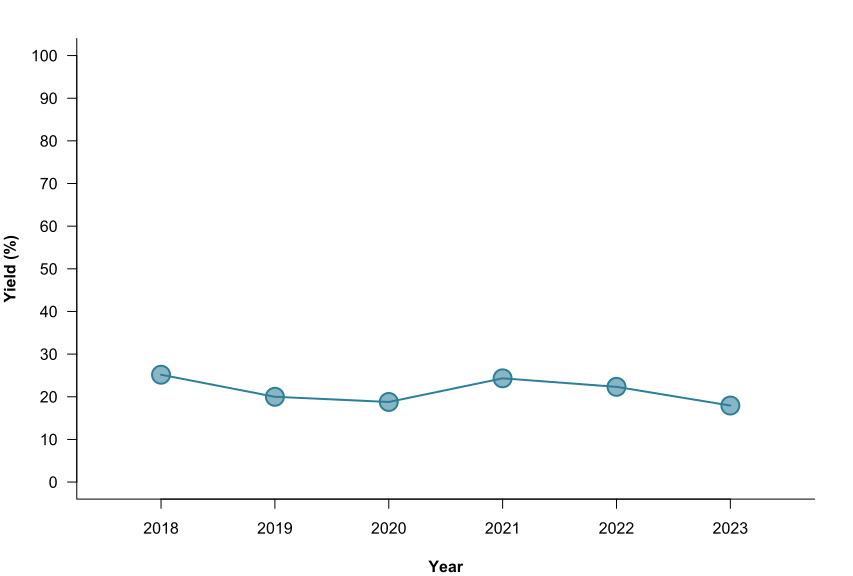
The yield of high-grade abnormalities on biopsy among participants aged 25–74 who attend colposcopy after higher risk screening results decreased from 25.2% in 2018 to 20.0% in 2019 and 18.8% in 2020. Following the introduction of a second follow-up episode and the addition of a new higher risk group, the yield of high-grade abnormalities initially increased to 24.3% in 2021, then fell to 22.3% in 2022 and 17.9% in 2023 (Figure 15.2).
Figure 15.2: Yield of high-grade abnormalities on biopsy among participants who attend colposcopy after higher risk screening results, by year, participants aged 25–74, 2018 to 2023
Source: AIHW analysis of NCSR data (NCSR RDE 11/07/2025). Data and notes for this figure are available in Table A15.2.