


Performance Indicator 8: LBC test in self-collection participants
Summary data for participants who have an LBC test after a self-collected sample in which oncogenic HPV (not 16/18) is detected
In 2024, of the 26,163 participants aged 25–74 who self-collected and whose HPV test was positive for oncogenic HPV (not 16/18), 76.3% had an LBC test within 3 months and 85.7% had an LBC test within 6 months.
LBC test in self-collection participants positive for oncogenic HPV (not 16/18)
Definition
Percentage of participants aged 25–74 who have an LBC test after a self-collected screening HPV test positive for oncogenic HPV (not 16/18) in a calendar year.
Rationale
Participants who self-collect their screening test and test positive for oncogenic HPV (not 16/18) are recommended to have a practitioner-collected sample within 6 weeks so that an LBC test can be performed. This indicator monitors compliance with this recommendation within 3 months, and within 6 months, by which time it is considered that most participants would have been able to attend an appointment with a practitioner.
Guide to interpretation
A higher percentage is better.
Data considerations
As a self-collected sample is not suitable for reflex LBC, if the HPV test detects oncogenic HPV (not 16/18), the participant needs to have a separate sample collected for a reflex LBC test to determine whether they are considered either intermediate risk or higher risk of significant cervical abnormality.
Under the renewed NCSP, prior to 1 July 2022, when all participants became eligible for self-collection, only those aged 30 or over who had never participated in cervical screening or were 2 years or more overdue for cervical screening were eligible to self-collect a vaginal sample for their HPV test. This means that the data for 2022 will comprise 6 months where self-collection was restricted and 6 months where self-collection was not restricted.
Time to LBC test is calculated from the date the self-collected HPV test was performed, not the date the participant received a referral to LBC. This means the reported rate is likely lower than if date of referral to LBC was used instead of date of self-collected HPV test.
Results
In 2024, there were 26,163 participants aged 25–74 who self-collected a sample for their primary screening HPV test and were found to be positive for oncogenic HPV (not 16/18). Of these participants, 76.3% had an LBC test within 3 months and 85.7% had an LBC test within 6 months of their primary screening HPV test.
LBC test in self-collection participants positive for oncogenic HPV (not 16/18) by age
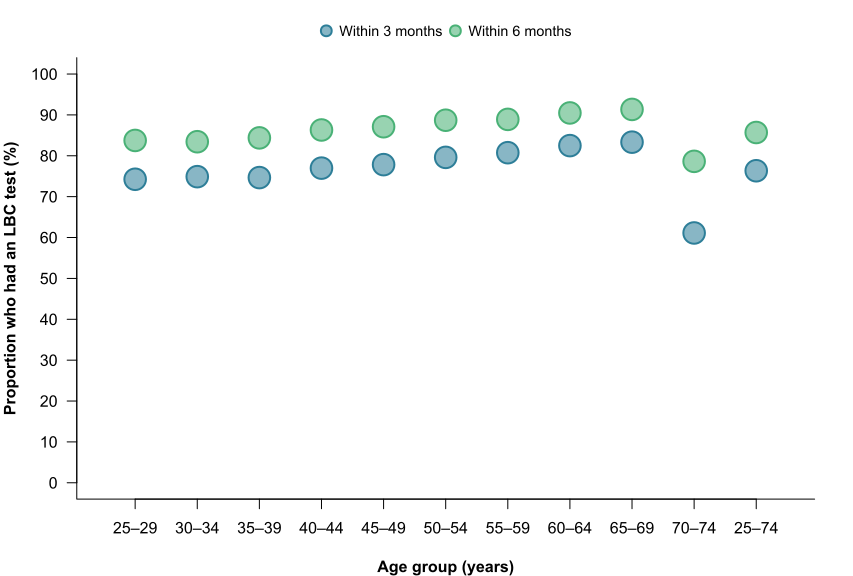
The proportion of participants who self-collected a sample for their primary screening HPV test that detected oncogenic HPV (not 16/18) who had an LBC test within 3 months was highest for participants aged 60–64 and 65–69 at 82.5% and 83.3%, respectively, and lowest for participants aged 70–74 at 61.1% (Figure 8.1).
The proportion who had an LBC test within 6 months was highest for participants aged 60–64 and 65–69 at 90.5% and 91.3%, respectively, and lowest for participants aged 70–74 at 78.6% (Figure 8.1).
Relatively lower proportions in participants aged 70–74 are likely related to the different recommendation for this age group, whereby participants with any oncogenic HPV detected will be recommended to attend colposcopy (although an LBC test may be performed when they return to their practitioner for a referral to colposcopy).
Figure 8.1: Proportion of participants who self-collected a sample for their primary screening HPV test that detected oncogenic HPV (not 16/18) who had an LBC test within 3 months and within 6 months, by age, 2024
Source: AIHW analysis of NCSR data (NCSR RDE 11/07/2025). Data and notes for this figure are available in Table A8.1a and Table A8.1b.
LBC test in self-collection participants positive for oncogenic HPV (not 16/18) trends
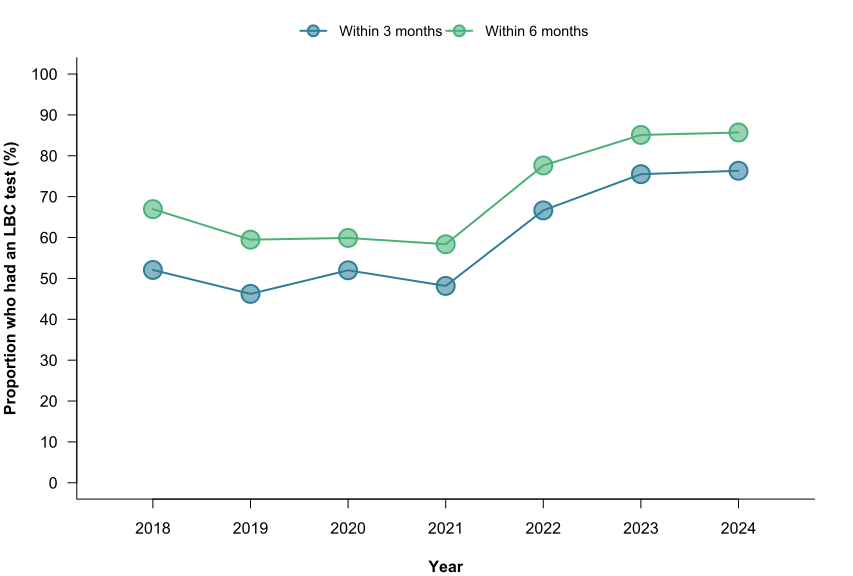
The proportion of participants who self-collected a sample for their primary screening HPV test that detected oncogenic HPV (not 16/18) and who had an LBC test within 3 months and within 6 months was similar over the years 2018 to 2021, with an increase in 2022, 2023, and 2024 (note that the number of participants who self-collected a sample in 2018 was very low, so data for this year are not as robust as later years).
For participants who had an LBC test within 3 months, this was around 50% for the years 2018 to 2021, increasing to 66.6% in 2022, before increasing to 75.5% in 2023 and 76.3% in 2024 (Figure 8.2).
For participants who had an LBC test within 6 months, this was around 60% for the years 2018 to 2021, increasing to 77.6% in 2022, before increasing to 85.1% in 2023 and 85.7% in 2024 (Figure 8.2).
Figure 8.2: Proportion of participants who self-collected a sample for their primary screening HPV test that detected oncogenic HPV (not 16/18) who had an LBC test within 3 months and within 6 months, participants aged 25–74, 2018 to 2024
Source: AIHW analysis of NCSR data (NCSR RDE 11/07/2025). Data and notes for this figure are available in Table A8.2a and Table 8.2b.
The high proportion of participants who self-collected a sample for their primary screening HPV test that detected oncogenic HPV (not 16/18) and who had an LBC test within 3 months and within 6 months in 2022, 2023, and 2024 may be a result of the change in the self-collection policy from July 2022, which allowed routine screeners to self-collect their sample.
These data suggest that routine screeners selecting a self-collected sample over practitioner-collected sample are more likely to return to their health practitioner for an LBC test when they have an intermediate risk HPV test result than under- or never-screened participants.